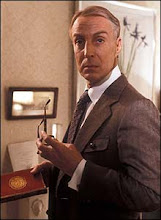
I don't mean Dudley Simpson's orchestral stuff here, nor Murray Gold's modern version, but the synth outpourings of Roger Limb et al in the 80s.
Well, it's like this. A lot of Doctor Who music is well written, vaguely atmospheric and reminds me of being a kid. It is also, unsurprisingly, almost devoid of serious emotional content. Adric's theme, the end of Earthshock - it's alright, but it's no Love Will Tear Us Apart. For me, this is good. It means I can listen to tunes without being battered by the contents of my own mind. Goodness knows why we like to see our pain reflected in our music - what on earth is this for? Is it to express the pain, through tapping and dancing or whatever, or is it to deepen it, and enable us to spend hours in brutal melancholy?
Listening to these synth themes obviates this problem. In fact the best of them are not even the 80s guys but the sheer brilliance of Delia Derbyshire, who seemed to have a feel for electronic sound like no-one else. the 80s stuff is much more conventional, it doesn't really push boundaries like hers does, but it does use synths and samples to tell the story in sound, which I find appealing. Peter Howell's music for The Five Doctors for example is the story, as much as the teleplay or the camerawork is.
The appeal is also nostalgic. I was given a record of Doctor Who music by a friend when I was 10, and I taped it; then later I bought it on CD; now I have it on iTunes (and am listening to it now in fact) - the form has shifted, like my own in these twenty two years, but the tunes still carry the information of those early days, when I could see Leckhampton Hill from my classroom and you could still have a teacher throw a board rubber at your head. In fact, when I listen to this, I am listening to the story of my own life, as I see it, as much as I am to the stories behind the music.
And it is music: sounds, phasing, rhythm, themes - it's just not three minute statements of the bleedin' obvious.
But there's little point overstating the theory or the nostalgia. I listen to it because I like it, because I can get on and do other stuff as well, and because I don't have to listen to some kid spewing out my own romantic problems in the process.
Now there might be another question here - why not just silence?
But that's another story altogether.
Showing posts with label little drummer boy. Show all posts
Showing posts with label little drummer boy. Show all posts
Saturday, 31 January 2009


Sunday, 4 May 2008
Frightening Television
By which I mean the rash of children's programmes of the 1970s and 1980s with genuinely affecting, even disturbing content: not just violence but supernatural or psychological horror, and programmes which had nothing to do with horror at all but whose title sequences were themselves weird or slightly disturbing (like Picture Box or Near and Far). For example: Changes, Chocky, many editions of Dramarama, Knightmare, Running Scared, Grange Hill at its best around 1986, Doctor Who of the mid 1970s and mid 1980s (Lytton's hand being crushed in Attack of the Cybermen being a prime instance) and more.
I don't have an explanation for this phenomenon as such, nor as to why we're not so keen to produce it today, though I think the brutality of mid-80s Doctor Who has an awful lot to do with its time - I think it was reflecting it, quite deliberately. There seems to be an ethereal strain to some popular culture that sets in around 1981 and lasts for four or five years, you can hear it in some of the electronic pop music of the time as well. I've often wondered if Peter Davison (whom I admire) was cast as Doctor Who precisely to be insubstantial - for what reason I am not really sure.
How on earth the PIF "The Natural Born Smoker" ever got allowed onto tv screens before 9pm amazes me, let alone broadcast at circa 5pm during CBBC in 1985. I recently saw this for the first time in 22 years on You Tube and it continues to horrify me, even to regress me, and I remember sitting in that living room, all alone, with the bizarre, vile character unfolding before my terrified eyes. I am certain I only saw it once - perhaps it was pulled.
At least it formed the inspiration for my first piece of published writing - in the school rag a few years later.
One memory eludes me to this day though and after hours of fruitless googling I am beginning to wonder if it exists at all:
An ordinary house in a suburban street; a boy hears a noise from upstairs and opens a brown door (I think labelled "Mark iv", leading into a long, rocky tunnel with some kind of computer and a hooded figure who then reveals a grotesque face.
I wonder if I am conflating The Deadly Assassin and something else here but it feels like a powerful memory, even if I can barely recall it. It has been with me a long time so I am sure there is something to it.
Can anyone help me with this?
I don't have an explanation for this phenomenon as such, nor as to why we're not so keen to produce it today, though I think the brutality of mid-80s Doctor Who has an awful lot to do with its time - I think it was reflecting it, quite deliberately. There seems to be an ethereal strain to some popular culture that sets in around 1981 and lasts for four or five years, you can hear it in some of the electronic pop music of the time as well. I've often wondered if Peter Davison (whom I admire) was cast as Doctor Who precisely to be insubstantial - for what reason I am not really sure.
How on earth the PIF "The Natural Born Smoker" ever got allowed onto tv screens before 9pm amazes me, let alone broadcast at circa 5pm during CBBC in 1985. I recently saw this for the first time in 22 years on You Tube and it continues to horrify me, even to regress me, and I remember sitting in that living room, all alone, with the bizarre, vile character unfolding before my terrified eyes. I am certain I only saw it once - perhaps it was pulled.
At least it formed the inspiration for my first piece of published writing - in the school rag a few years later.
One memory eludes me to this day though and after hours of fruitless googling I am beginning to wonder if it exists at all:
An ordinary house in a suburban street; a boy hears a noise from upstairs and opens a brown door (I think labelled "Mark iv", leading into a long, rocky tunnel with some kind of computer and a hooded figure who then reveals a grotesque face.
I wonder if I am conflating The Deadly Assassin and something else here but it feels like a powerful memory, even if I can barely recall it. It has been with me a long time so I am sure there is something to it.
Can anyone help me with this?
Saturday, 8 March 2008
It's Always The Same/ It's Just A Shame That's All
Can't remember who did this - Genesis probably, in fact I think it was them.
I drew a picture of it for my dad, so much did I like it in 1982 or 1983 or whenever.
He was, like, not getting out of bed until 12.15 for Grandstand and I was like watching Saturday Superstore or something and listening to this somehow, somewhere, and so I drew this cartoon strip with me listening to this track and trying to get him up or whatever. Don't really recall. Don't suppose it matters. Long time ago. Now I'm a long way grown up and it clearly has no relevance to my life....
Still. It's got a point, though, hasn't it?
I drew a picture of it for my dad, so much did I like it in 1982 or 1983 or whenever.
He was, like, not getting out of bed until 12.15 for Grandstand and I was like watching Saturday Superstore or something and listening to this somehow, somewhere, and so I drew this cartoon strip with me listening to this track and trying to get him up or whatever. Don't really recall. Don't suppose it matters. Long time ago. Now I'm a long way grown up and it clearly has no relevance to my life....
Still. It's got a point, though, hasn't it?
Wednesday, 27 February 2008
T
I have received some correspondence (yes, despite losing all of my hits I still have a regular reader) on the subject of my name. They write that they are happy to refer to me as "T". This is in return for my official permission, certified by strict guidelines handed to all local authorities by the regulatory company OFTD.
In today's Times you can see the desecration wreaked upon my given name, the appalling degredation of a once pleasant appellation. Imagine it given its own adjective, circa 1989: "oh my god, that's so T"; "you didn't, that is SO T"; "ho ho you are such a T". In case anyone is interested, all I will say is that appears in a picture on one of the news pages and it really is not funny, at all, really. It meant that a typical encounter circa 1990 went like this:
TD: Hello, my name's T.
Beautiful girl: fnarr fnarr, snurk snurk, yuk yuk! [walks off and points at TD at which loads of other tossers laugh].
In today's Times you can see the desecration wreaked upon my given name, the appalling degredation of a once pleasant appellation. Imagine it given its own adjective, circa 1989: "oh my god, that's so T"; "you didn't, that is SO T"; "ho ho you are such a T". In case anyone is interested, all I will say is that appears in a picture on one of the news pages and it really is not funny, at all, really. It meant that a typical encounter circa 1990 went like this:
TD: Hello, my name's T.
Beautiful girl: fnarr fnarr, snurk snurk, yuk yuk! [walks off and points at TD at which loads of other tossers laugh].
Friday, 15 February 2008
On The Negativism of Things
This phenomenon, known as "the tin drummer is depressed about various piss-awful events in his ghastly, insignificant life"-syndrome, was documented in 1981 by the noted drummerologist "Miss Rochford", sometimes known as "the drummer's Reception teacher". It first appeared in his disgust at seeing the blue-jacketed back of his father walk away through the vast windows of his ancient HORSA classroom, back to the Hillman Hunter, and away from the screaming drummer, by now weeping in Miss Rochford's lap (and very comfy it was too). It subsequently appeared at various intervals: namely, 1986, 1990, 1993, 1995, 1998 and most years after.
It is barely an elusive phenomenon; the drummerologist "Hugh of Lincoln" noted its appearance at sporadic intervals and tied these together under the name "winter & alcohol", but failed, in the opinion of many critics, successfully to map the drummer's negativism onto real world events. The philosopher Phred Tap reckons that 2001 was a turning point. He writes: "the authoritarian victory of New Labour, versus the complete descent into populist incompetence of conservatism, wrecked the drummer's political mind for ever." (The Tin Drummer: A Political Reckoning) In Don't Stand So Close to Me (1999), the critic and historian Kymant Carshalton writes: "TD was a failed enterprise from the beginning: but this being the case, his efforts to carve a niche in the world were half-hearted to say the very least. Trying to get himself arrested by writing secretive libels of Tony Blair was, to put it generously, ignoble: to put it uncharitably, it was the act of a fool. And a twat."
Nonetheless, it seems that 2008 marked a descent into rabid rubbish negativism for the damn sake of it. The archivist Primus Eliot wrote in his monologue The Tin Drummer is All Measure of Value (2010) that: "...in this year [2008] the twat become heroically self-absorbed. Indeed, he was so obsessed with his personal problems he forgot to shit. This caused legendary problems at work, when he failed to turn up for a lesson for 42 minutes because he was trying to evacuate six weeks of garbage from his colon and in doing so bankrupted his school because the bog pipes were blocked for eight miles from the u-bend." Historian Nigel Ob wrote in his book Calling All the Hero (2009) that "the tin drummer became a crashing bore, clogging up the blogosphere with his bizarre, drunken, self-lacerating rantings. It was only later that he realised, to his eternal credit, that no-one gave a toss, and wanted him to shut the fuck up".
The contradictory nature of the last quote will not be lost on the reader.
However: the lesson was learned; the tin drummer continued to write - but he focused more on subjects he could be more positive about.
It is barely an elusive phenomenon; the drummerologist "Hugh of Lincoln" noted its appearance at sporadic intervals and tied these together under the name "winter & alcohol", but failed, in the opinion of many critics, successfully to map the drummer's negativism onto real world events. The philosopher Phred Tap reckons that 2001 was a turning point. He writes: "the authoritarian victory of New Labour, versus the complete descent into populist incompetence of conservatism, wrecked the drummer's political mind for ever." (The Tin Drummer: A Political Reckoning) In Don't Stand So Close to Me (1999), the critic and historian Kymant Carshalton writes: "TD was a failed enterprise from the beginning: but this being the case, his efforts to carve a niche in the world were half-hearted to say the very least. Trying to get himself arrested by writing secretive libels of Tony Blair was, to put it generously, ignoble: to put it uncharitably, it was the act of a fool. And a twat."
Nonetheless, it seems that 2008 marked a descent into rabid rubbish negativism for the damn sake of it. The archivist Primus Eliot wrote in his monologue The Tin Drummer is All Measure of Value (2010) that: "...in this year [2008] the twat become heroically self-absorbed. Indeed, he was so obsessed with his personal problems he forgot to shit. This caused legendary problems at work, when he failed to turn up for a lesson for 42 minutes because he was trying to evacuate six weeks of garbage from his colon and in doing so bankrupted his school because the bog pipes were blocked for eight miles from the u-bend." Historian Nigel Ob wrote in his book Calling All the Hero (2009) that "the tin drummer became a crashing bore, clogging up the blogosphere with his bizarre, drunken, self-lacerating rantings. It was only later that he realised, to his eternal credit, that no-one gave a toss, and wanted him to shut the fuck up".
The contradictory nature of the last quote will not be lost on the reader.
However: the lesson was learned; the tin drummer continued to write - but he focused more on subjects he could be more positive about.
Monday, 11 February 2008
My Neem - My Name's Tegan Jovanka
The title of this post refers to a legendarily fluffed line from Janet Fielding in Doctor Who's 1981 epic Logopolis. To this day I have no idea why the BBC allowed such a blatantly fucked line to be recorded; perhaps they were running out of time or something.
Anyway. Giving your name to someone is a big deal and to me it's always been a doubly difficult ordeal, because I have a totally embarrassing name, at least if you were a child of the 80s and early 90s.
A typical conversation would go a bit like this:
"Hello, my name's Phil."
"Er, hi, I'm TD."
"TD, [sniggers], hey - I've got loadsamoney, loadsamoney, hey have you heard this - "oooow, god, you never let me do anything, tsk, god, tsk, tchoh..."
and so on. Obviously my name isn't TD, but it stands for [substitute name you couldn't hear without sniggering between 1986 and 1996].
Even though this phase of history seems to have passed I still loathe telling people my name, and prefer to take the age old route of anonymity. By a staggering coincidence, most of the people I meet are not interested in knowing my name, despite telling me everything from their favourite cereal to the sexual position that causes them most difficulty. I like such people. They cause me no trouble and I learn a lot from them, such as their work problems, their relationship "issues", their troubled childhood and their fears about death (I've heard it all before, honestly. You could have no fear of death that I haven't heard, indeed shared). Given that people have been anonymous or pseudonymous since we were scrawling damnfool images on caves, it seems a bit odd for certain bloggers to demand to know the identity of everyone who posts, but that is by the bye. I can just imagine a conversation between my tutor and me circa 1997:
"so, TD, what do you think of the Owl and the Nightingale?"
"Well, it needs to be discounted on the basis that the author omitted their name. I mean, for all we know it could of been the Pearl poet sock-puppeting."
"But-but that's outrageous. Sock-puppetry is-"
etc.
So I try not to give my name unless absolutely necessary. At least if people do know it then they don't call me "mate", "pal" or "bro" (not that I get called bro very often). Instead they call me "T" (which stands for "even more embarrassing shortened form of embarrassing name"); which is totally unacceptable unless I have clearly given them permission to do so. At time of counting only 2 people have the right to call me this, not counting my parents, who do not, and never will have, permission, but who call me this anyway.
Why have I set upon this diversion? Because I am bored, and a little tipsy, and not working, and I cannot be bothered to indulge a long rant about the government's latest folly against civil liberties, whatever it is (let me guess - it's an entitlement, or right of some kind).
"My neem - my name's Tegan Jovanka. I'd like to speak to the pilot."
So would I, my dear, so would I.
Anyway. Giving your name to someone is a big deal and to me it's always been a doubly difficult ordeal, because I have a totally embarrassing name, at least if you were a child of the 80s and early 90s.
A typical conversation would go a bit like this:
"Hello, my name's Phil."
"Er, hi, I'm TD."
"TD, [sniggers], hey - I've got loadsamoney, loadsamoney, hey have you heard this - "oooow, god, you never let me do anything, tsk, god, tsk, tchoh..."
and so on. Obviously my name isn't TD, but it stands for [substitute name you couldn't hear without sniggering between 1986 and 1996].
Even though this phase of history seems to have passed I still loathe telling people my name, and prefer to take the age old route of anonymity. By a staggering coincidence, most of the people I meet are not interested in knowing my name, despite telling me everything from their favourite cereal to the sexual position that causes them most difficulty. I like such people. They cause me no trouble and I learn a lot from them, such as their work problems, their relationship "issues", their troubled childhood and their fears about death (I've heard it all before, honestly. You could have no fear of death that I haven't heard, indeed shared). Given that people have been anonymous or pseudonymous since we were scrawling damnfool images on caves, it seems a bit odd for certain bloggers to demand to know the identity of everyone who posts, but that is by the bye. I can just imagine a conversation between my tutor and me circa 1997:
"so, TD, what do you think of the Owl and the Nightingale?"
"Well, it needs to be discounted on the basis that the author omitted their name. I mean, for all we know it could of been the Pearl poet sock-puppeting."
"But-but that's outrageous. Sock-puppetry is-"
etc.
So I try not to give my name unless absolutely necessary. At least if people do know it then they don't call me "mate", "pal" or "bro" (not that I get called bro very often). Instead they call me "T" (which stands for "even more embarrassing shortened form of embarrassing name"); which is totally unacceptable unless I have clearly given them permission to do so. At time of counting only 2 people have the right to call me this, not counting my parents, who do not, and never will have, permission, but who call me this anyway.
Why have I set upon this diversion? Because I am bored, and a little tipsy, and not working, and I cannot be bothered to indulge a long rant about the government's latest folly against civil liberties, whatever it is (let me guess - it's an entitlement, or right of some kind).
"My neem - my name's Tegan Jovanka. I'd like to speak to the pilot."
So would I, my dear, so would I.
Thursday, 20 December 2007
Ever Fallen in Love with Someone You Shouldn't Have?
No. Nor have I, obviously. Ca va sans dire.
Actually it used to happen distressingly frequently, back in the mists of time; I eventually figured out (when I fell in love properly, and could distinguish the difference) that it was a kind of coping mechanism: faced with situations or problems I was not keen to dwell on my brain seemed to trip a switch and start obsessing about someone, always wonderful and always inaccessible, instead of focusing on the issues at hand and dealing with them. So I learned that my pysche is essentially cowardly, sneaky, and romantic. I mean was. What a ghastly mixture. At 23 I worked out that this facility for love was also a brilliant way of achieving regression hypnosis: I could live as a 13 year old again (I mean 13 year olds of my shy disposition and slightly more restrained generation): not eating, not sleeping, not concentrating on anything except her. Incidentally as a genuine 13 year old when I did this many of my classmates took this her to be Mrs Thatcher, but this was not the case (my dad, on the other hand...). I always chose the most horrendously inappropriate people for the objects of desire, which continued into my twenties, although then it was the same person for a couple of years. But they would be all, for however long it took...for whatever was really bothering me to die down or be properly repressed. Only once did I confess my neurotic-love to its object, and the stakes were not high so it didn't matter: later on the stakes were infinitely high and I derived even more delicious, self-flagellating lovesickness from them.
Now that I come to write this stuff down it makes me think more of the idea of inaccessible women, and their pivotal roles in art and literature (Beatrice?)...but it's probably best not to dwell on that for too long, if at all. It also makes me think more about that awful, slimy creature, myself, but not for too long.
I don't write any of this thinking it's unique or unusual, btw. Just because it came to me in a dream, one of those odd ones that leave you slightly out of kilter for the whole day.
And I had been reading about fairy circles, alternate dimensions and psychoactive drugs that evening.
Actually it used to happen distressingly frequently, back in the mists of time; I eventually figured out (when I fell in love properly, and could distinguish the difference) that it was a kind of coping mechanism: faced with situations or problems I was not keen to dwell on my brain seemed to trip a switch and start obsessing about someone, always wonderful and always inaccessible, instead of focusing on the issues at hand and dealing with them. So I learned that my pysche is essentially cowardly, sneaky, and romantic. I mean was. What a ghastly mixture. At 23 I worked out that this facility for love was also a brilliant way of achieving regression hypnosis: I could live as a 13 year old again (I mean 13 year olds of my shy disposition and slightly more restrained generation): not eating, not sleeping, not concentrating on anything except her. Incidentally as a genuine 13 year old when I did this many of my classmates took this her to be Mrs Thatcher, but this was not the case (my dad, on the other hand...). I always chose the most horrendously inappropriate people for the objects of desire, which continued into my twenties, although then it was the same person for a couple of years. But they would be all, for however long it took...for whatever was really bothering me to die down or be properly repressed. Only once did I confess my neurotic-love to its object, and the stakes were not high so it didn't matter: later on the stakes were infinitely high and I derived even more delicious, self-flagellating lovesickness from them.
Now that I come to write this stuff down it makes me think more of the idea of inaccessible women, and their pivotal roles in art and literature (Beatrice?)...but it's probably best not to dwell on that for too long, if at all. It also makes me think more about that awful, slimy creature, myself, but not for too long.
I don't write any of this thinking it's unique or unusual, btw. Just because it came to me in a dream, one of those odd ones that leave you slightly out of kilter for the whole day.
And I had been reading about fairy circles, alternate dimensions and psychoactive drugs that evening.
Sunday, 7 January 2007
R Tape Loading Error, 0:1
via Dizzy I found this website. I think that is all there is, but it made me laugh. In fact it's a myth that you'd load something for 15 minutes on a Spectrum and then it would trump your expectations with this oft-seen message. In the classic Speccy age (ie before Amstrad took over Sinclair) the 48K games generally took less than 10 minutes to load and many only a couple of minutes (less than it takes my pc to wheeze Age of Empires into gear). A brilliant game like Horace Goes Skiing took hardly any time at all and was extremely reliable. Of course it wasn't the games that were the problem, but the cable-connected tape recorder which sometimes had to be propped up, or the cables sellotaped in. It was really later, when the redesigned (and much less sexy) Amstrad Spectrums (or should that be Spectra) had built in tape decks and 128K that games could take the thick end of 20 minutes to load.
The point for me about the Sinclair ZX Spectrum for me was this: it was an idiosyncratic little thing, beautiful in its own way but quite hard to use (a clumsy 8 year old like me was no good with the rubber keys). The error messages like the famous one above were masterpieces of stubborn understatement, often insistently cropping up at the least appropriate moment. You couldn't type rude messages onto it because the keys always printed command words at the beginning of a line, which was a shame but it made writing (or in my case mostly copying out) BASIC programs easier. Even the data systems were idiosyncratic, like the microdrive, which I never had but always wanted: whatever else it may have been it was sexy and fitted the computer's design well. Its graphics were poor compared to the C64 and the Amstrad CPC464, but I always felt a little...underwhelmed using these devices. They lacked a joie de vivre that the Speccy made its own.
At least you got error messages regularly with a Spectrum: my pc just freezes or restarts with no warning at all most of the time and you've no idea what's gone wrong.
The point for me about the Sinclair ZX Spectrum for me was this: it was an idiosyncratic little thing, beautiful in its own way but quite hard to use (a clumsy 8 year old like me was no good with the rubber keys). The error messages like the famous one above were masterpieces of stubborn understatement, often insistently cropping up at the least appropriate moment. You couldn't type rude messages onto it because the keys always printed command words at the beginning of a line, which was a shame but it made writing (or in my case mostly copying out) BASIC programs easier. Even the data systems were idiosyncratic, like the microdrive, which I never had but always wanted: whatever else it may have been it was sexy and fitted the computer's design well. Its graphics were poor compared to the C64 and the Amstrad CPC464, but I always felt a little...underwhelmed using these devices. They lacked a joie de vivre that the Speccy made its own.
At least you got error messages regularly with a Spectrum: my pc just freezes or restarts with no warning at all most of the time and you've no idea what's gone wrong.
Subscribe to:
Posts (Atom)