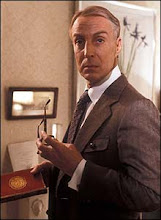
Well, while I'm here (not I'm not pissed, just couldn't sleep), I thought I'd update the world on the TTD Doomsday Clock. This interesting device measures the nearness of Threads to my imagination. At the moment it is quite close: the ideas and vocabulary of the teleplay are constantly at hand. For example, on Saturday the Thornbury Tesco suffered a powercut. Clearly my first thought was that a nearby nuclear explosion was to blame. It turned out to be rain. There was no need to panic buy, and no chance of hearing Five Live interrupting their premiership coverage to tell us that a US Carrier had been sunk in the Persian Gulf.
Bloody hell- the end of the world, as read by Richard Bacon. It's enough to make you seek out the prompt radiation.
This might have been influenced by a recent re-reading of Children of the Dust by Louise Lawrence. This is an intriguing book, published in 1985, which posits a nuclear war as seen from er, the banks of the Severn (the other side from Berkeley and Hill). In this novel, written for teenagers, there are explosions at - Bristol, Oldbury, Cheltenham, Gloucester - everywhere. And the destruction is so complete that mutations become dominant from the next generation onwards. These mutations eventually form the basis of a new species of human, one with the memory of nuclear war embedded in their psyches. The curious thing about this novel is that there is a strong biblical subtext - this is a kind of Noah's Ark, except that the flood was caused by us, given space by God to do so, for reasons of his own, namely the new, superior race that was to emerge. In short - we, homo sapiens, had failed. We were to be allowed to fail in order to be destroyed by our own hand. The replacements, a kind of cross between Stone Age man and the Tomorrow People, would not repeat the mistakes.
Or so the story went. A silly one, at the end.
I also re-read Martin Amis's Einstein's Monsters last week. This is a collection of 5 short stories on the subject of nuclear war. 3 are crap, two are good. The worst bit, actually, is Amis' introduction, which is typical 80s Amis, when he was still full of his own shit. He routinely denounces writers he doesn't agree with as "subhuman" but does not appear to have done *any* research on his subject beyond reading Jonathan Schell's book on it - he hasn't watched Threads or the Day After or The War Game, for example. Like a lot of writers, he pulls bits of quantum theory out of his arse and pretends he knows about physics and maths. He also completely gets geopolitics arse over tit and confidently announces we cannot possibly defeat the Soviets on any level, nuclear or otherwise, ever. This was written in 1987.
"Formal First"? Fuck me, Mart, not in maths, mate; not in maths.
I also had the deflating experience of re-reading The H Bomb Girl by Stephen Baxter, which on a second reading turns out to have been copied straight out of Threads, and to have utterly mixed up 80s and 60s Civil Defence, and to have snuck in some shit references to Reagan and Thatcher as wanting to prolong the Cold War - how dishonest can you be? I mean really, how much of a liar do you have to be to think that Reagan, who instigated and carried through summit talks with Gorby with the ideal of getting rid of all nuclear weapons, just wanted to keep the conflict simmering for ever? And Thatch? Did she *really* want a strong USSR in perpetuity? Bollocks did she - she wanted it defeated by its own subjects, as it was (and the forces of economic necessity, etc etc). Bloody hell - I'll say this for your lefty writer - they can be utterly, deliberately, ignorant.
In that respect, maybe Daisy Dukes and bikinis on top have their attractions after all.
The TTD Doomsday Clock stands at 11.42pm
Showing posts with label literature. Show all posts
Showing posts with label literature. Show all posts
Tuesday, 17 August 2010


Thursday, 18 February 2010
Bill Haydon
I've spent a lot of time thinking about this guy. I've just finished Tinker, Tailor, Soldier Spy, and listened to it on the radio, so clearly I've experienced quite a lot of Bill Haydon lately. Briefly, my problem is this. He's an absolute fucking bastard. I mean the bastard of all bastards. He is a role model for the younger men at the Circus, is No2, is generally idolised - and has been a Soviet mole for 20 years! Worse than that, according to the Radio 4 version, he reckons he's a Colonel in Soviet Intelligence!
If I am writing this with all the subtlety of a 4 year old who's just realised that the witch in Hansel and Gretel isn't as nice as she first seemed, then fair enough. But, even though it is obvious who the mole is from an early stage, the unmasking of the hero of all these characters is still a shock. It's a shock you feel on the other characters' behalf more than on your own. It's the betrayal, the smiling, charismatic betrayal he has carried with him all this time - and which has killed so many people along the way. The brilliance of his career at the Circus is vastly exceeded by the brilliance of his career with the Soviets. Bastard Bill Haydon, not only being a good spy and a brilliant mole, but being loved so much by everyone else. Being loved and cutting it to pieces.
When he is debriefed by Smiley, he gives nothing away, and only makes Smiley feel that Haydon as a man doesn't reall exist at all. This is awful, because you desperately want Haydon to be beaten up, kneecapped and shot. But - the novel is only vaguely about spies and spy rings. Its about love and hate. Smiley does not, cannot hate Haydon, Guillam has to make himself want to hurt him. For neither of them does revenge really enter into it - nor does Haydon expect it to. He expects to keep his good reputation, his history of service, his charisma - all intact. He's not delusional as such, merely un-self aware. Smiley loves Ann of course, and Haydon slept with her - not because he loved her, but much worse than that - on orders. Subverting love altogether. Haydon tries to communicate to Smiley some kind of love for the USSR but it only comes out as a frustrated aristocrat trying to influence the world when he knows his own country can't. Smiley's greatest gift in this book is his love - of Ann, of duty, of Britain, even of his colleagues at the Service (eg Connie Sachs).
Bill Haydon is a sore, but not a festering one - he doesn't itch enough for that. He doesn't make enough itching. As a result, will he achieve the fame and notoriety he wanted? Will he be loved?
Nope. Chances are, even if he hadn't have been topped by another man who deeply loved him, ie Jim Prideaux, he'd have been like Philby. A scalp, but one who doesn't quite know his place. And the historians he thinks will write his apologia, thanks to Smiley, probably will never get to know about him.
He will be nothing, the net result of his betrayals.
Of course, he's based on that cunt Philby, who ruthlessly exposed agents in the Soviet Union only for them to be shot, and who was convinced he was a Colonel in the KGB only to find that he was, instead, a largely washed up communist arsehole, who like all the other fuckers, drank too much vodka.
In fact, I hate Bill Haydon so much, I'm changing my name - to Bill Haydon.
If I am writing this with all the subtlety of a 4 year old who's just realised that the witch in Hansel and Gretel isn't as nice as she first seemed, then fair enough. But, even though it is obvious who the mole is from an early stage, the unmasking of the hero of all these characters is still a shock. It's a shock you feel on the other characters' behalf more than on your own. It's the betrayal, the smiling, charismatic betrayal he has carried with him all this time - and which has killed so many people along the way. The brilliance of his career at the Circus is vastly exceeded by the brilliance of his career with the Soviets. Bastard Bill Haydon, not only being a good spy and a brilliant mole, but being loved so much by everyone else. Being loved and cutting it to pieces.
When he is debriefed by Smiley, he gives nothing away, and only makes Smiley feel that Haydon as a man doesn't reall exist at all. This is awful, because you desperately want Haydon to be beaten up, kneecapped and shot. But - the novel is only vaguely about spies and spy rings. Its about love and hate. Smiley does not, cannot hate Haydon, Guillam has to make himself want to hurt him. For neither of them does revenge really enter into it - nor does Haydon expect it to. He expects to keep his good reputation, his history of service, his charisma - all intact. He's not delusional as such, merely un-self aware. Smiley loves Ann of course, and Haydon slept with her - not because he loved her, but much worse than that - on orders. Subverting love altogether. Haydon tries to communicate to Smiley some kind of love for the USSR but it only comes out as a frustrated aristocrat trying to influence the world when he knows his own country can't. Smiley's greatest gift in this book is his love - of Ann, of duty, of Britain, even of his colleagues at the Service (eg Connie Sachs).
Bill Haydon is a sore, but not a festering one - he doesn't itch enough for that. He doesn't make enough itching. As a result, will he achieve the fame and notoriety he wanted? Will he be loved?
Nope. Chances are, even if he hadn't have been topped by another man who deeply loved him, ie Jim Prideaux, he'd have been like Philby. A scalp, but one who doesn't quite know his place. And the historians he thinks will write his apologia, thanks to Smiley, probably will never get to know about him.
He will be nothing, the net result of his betrayals.
Of course, he's based on that cunt Philby, who ruthlessly exposed agents in the Soviet Union only for them to be shot, and who was convinced he was a Colonel in the KGB only to find that he was, instead, a largely washed up communist arsehole, who like all the other fuckers, drank too much vodka.
In fact, I hate Bill Haydon so much, I'm changing my name - to Bill Haydon.
Tuesday, 26 January 2010
Poor Piggy
Proof, if any were needed, that the obesity crisis is a grave health issue.
Here we see the consequences of being overweight. Not only are you vulnerable to psychopaths levering massive rocks down at you, but you don't even get a decent death scene.
The rock struck Piggy a glancing blow from chin to knee; the conch
exploded into a thousand white fragments and ceased to exist. Piggy,
saying nothing, with no time for even a grunt, traveled through the air
sideways from the rock, turning over as he went. The rock bounded
twice and was lost in the forest. Piggy fell forty feet and landed on his
back across the square red rock in the sea. His head opened and stuff
came out and turned red. Piggy’s arms and legs twitched a bit, like a
pig’s after it has been killed. Then the sea breathed again in a long, slow
sigh, the water boiled white and pink over the rock; and when it went,
sucking back again, the body of Piggy was gone.
"twitched a bit"?
"stuff came out"?
"like a pig's after it has been killed"?
"no time for even a grunt"?
Where is the dignity? The sense of a life lost? The utter senseless waste? The deep tragedy of the death of civilisation?
No - "stuff came out".
Piggy's death is made comical by the shape and bearing of his bloated body. Had Piggy been slim, like Simon, there'd have been real emotion in his death.
My students yesterday laughed at the death of Piggy.
Laughed.
Kids - don't eat that pie. It's not worth it -
Do you want a comical death?
Here we see the consequences of being overweight. Not only are you vulnerable to psychopaths levering massive rocks down at you, but you don't even get a decent death scene.
The rock struck Piggy a glancing blow from chin to knee; the conch
exploded into a thousand white fragments and ceased to exist. Piggy,
saying nothing, with no time for even a grunt, traveled through the air
sideways from the rock, turning over as he went. The rock bounded
twice and was lost in the forest. Piggy fell forty feet and landed on his
back across the square red rock in the sea. His head opened and stuff
came out and turned red. Piggy’s arms and legs twitched a bit, like a
pig’s after it has been killed. Then the sea breathed again in a long, slow
sigh, the water boiled white and pink over the rock; and when it went,
sucking back again, the body of Piggy was gone.
"twitched a bit"?
"stuff came out"?
"like a pig's after it has been killed"?
"no time for even a grunt"?
Where is the dignity? The sense of a life lost? The utter senseless waste? The deep tragedy of the death of civilisation?
No - "stuff came out".
Piggy's death is made comical by the shape and bearing of his bloated body. Had Piggy been slim, like Simon, there'd have been real emotion in his death.
My students yesterday laughed at the death of Piggy.
Laughed.
Kids - don't eat that pie. It's not worth it -
Do you want a comical death?
Saturday, 31 October 2009
Three Types of Simile
Here's something I wrote while deeply bored some time ago. As you can imagine, I'm still desperately bored - too bored even to blog propely, though I've started posting again over at CTS. I had a volume of Hardy and a cup of tea to hand when I wrote it.
The first type of simile simply tries to invoke some genuine quality of a real object through reference to another object. The relevant cliché is “as hot as an oven”. With these “concrete” similes, the danger for the writer is that cliché is difficult to avoid; exaggeration also creeps up on you. But the possibility is always there for a simple simile of this type to contain other, hidden meanings or connotations. Take this example from Thomas Hardy’s poem ‘The Clock Winder’: “It is as dark as a cave”. Nothing too complicated there, the image is clear, the reference, obvious. But think for a while on the nature of caves. Claustrophobic, tapering into ancient rocks, the home of unknown streams, stalactites and stalagmites, the origins of human civilisation, hidden realms. The darkness of the very ordinary night Hardy is explaining now takes on a more psychological aspect. The depth of similes such as these is, of course, entirely up to the writer. But writers and students should be encouraged to think very carefully about the objects they choose to place into their similes.
The second type does the same thing, but invokes non-existent objects that people are nonetheless familiar with. For example: “Quick feet as light/As the feet of a sprite” from the poem ‘Signs and Tokens’. It is easy to see the reference, even though there are (as far as we know) no such things as sprites. The word “sprite” itself has become almost a metaphor for quickness and lightness. With this kind of simile a writer can convey some sense of numinosity or give an ethereal atmosphere to a scene or idea. A clichéd example of this type would be something like, “She looked like an angel”. A better one would be this, from Hardy’s poem ‘Apostrophe to an Old Psalm Tune’, “..sweet as angels’ laughters”.
The third type of simile intends to reference the object or quality only vaguely or slightly to anything, and is instead a satire, or a play with language for its own sake. This is exceptionally difficult to write appropriately. Most usually it is done to make the reader question the writing process and think about the difficulty of communication. It is mainly associated with modernist and post-modernist writing. An example would be “The years were like the cries of children”, in which a sense of fear is invoked, but otherwise the similarities are slight or non-existent.
These types of simile can also be adapted, extended or cut. Often a writer will slide the usual expressions into “hot like an oven” or “oven-hot” or “with the heat of an oven” or some other phrase. To avoid cliché and extend the image – though this has to be done with caution – a writer might take a simile like “she looked like an angel” and change it to “she looked like an angel, full of its sadness for humankind” – the idea being to give the object of reference more detail in order to make the image more complex. In the following quotation Hardy doubles his simile to give it more shades of meaning:
From tides the lofty coastlands screen
Come smitings like the slam of doors
Or hammerings on hollow floors
(from ‘The Wind’s Prophecy’)
The first type of simile simply tries to invoke some genuine quality of a real object through reference to another object. The relevant cliché is “as hot as an oven”. With these “concrete” similes, the danger for the writer is that cliché is difficult to avoid; exaggeration also creeps up on you. But the possibility is always there for a simple simile of this type to contain other, hidden meanings or connotations. Take this example from Thomas Hardy’s poem ‘The Clock Winder’: “It is as dark as a cave”. Nothing too complicated there, the image is clear, the reference, obvious. But think for a while on the nature of caves. Claustrophobic, tapering into ancient rocks, the home of unknown streams, stalactites and stalagmites, the origins of human civilisation, hidden realms. The darkness of the very ordinary night Hardy is explaining now takes on a more psychological aspect. The depth of similes such as these is, of course, entirely up to the writer. But writers and students should be encouraged to think very carefully about the objects they choose to place into their similes.
The second type does the same thing, but invokes non-existent objects that people are nonetheless familiar with. For example: “Quick feet as light/As the feet of a sprite” from the poem ‘Signs and Tokens’. It is easy to see the reference, even though there are (as far as we know) no such things as sprites. The word “sprite” itself has become almost a metaphor for quickness and lightness. With this kind of simile a writer can convey some sense of numinosity or give an ethereal atmosphere to a scene or idea. A clichéd example of this type would be something like, “She looked like an angel”. A better one would be this, from Hardy’s poem ‘Apostrophe to an Old Psalm Tune’, “..sweet as angels’ laughters”.
The third type of simile intends to reference the object or quality only vaguely or slightly to anything, and is instead a satire, or a play with language for its own sake. This is exceptionally difficult to write appropriately. Most usually it is done to make the reader question the writing process and think about the difficulty of communication. It is mainly associated with modernist and post-modernist writing. An example would be “The years were like the cries of children”, in which a sense of fear is invoked, but otherwise the similarities are slight or non-existent.
These types of simile can also be adapted, extended or cut. Often a writer will slide the usual expressions into “hot like an oven” or “oven-hot” or “with the heat of an oven” or some other phrase. To avoid cliché and extend the image – though this has to be done with caution – a writer might take a simile like “she looked like an angel” and change it to “she looked like an angel, full of its sadness for humankind” – the idea being to give the object of reference more detail in order to make the image more complex. In the following quotation Hardy doubles his simile to give it more shades of meaning:
From tides the lofty coastlands screen
Come smitings like the slam of doors
Or hammerings on hollow floors
(from ‘The Wind’s Prophecy’)
Thursday, 2 April 2009
He's Fucking Codding, is Clough
On re-reading The Damned Utd, before going to see the film.
I think the novel is a brave attempt to write as someone else. Someone who was, in a way, public property for a long time, partly out of choice. So one of the difficulties for the author is that people already think they know this character. The temptation for the writer must then be to try and uncover new things about the man: but he is recently dead, and so emotions and relationships are raw, and unbiased evidence thin on the ground. How do you get round this? You let the man himself speak - copy interviews and columns - and you invent a personality. In this case you have an author whose speciality is State of the Nation type stuff. So your invented personality contains elements of what you understand to be the contemporary culture, and what you believe to be key elements of the time. In this case: despair, anger, and collapse generally. These become, in the case of Brian Clough, the dominant elements of the characterisation in the novel.
However I don't think David Peace is deliberately casting Clough in a bad light, or defaming him, as far as that is possible: I think he is trying to pinpoint the essence of a man through his time, and through his greatest failure. In a way, how we deal with failure is key to how we develop as people. By showing the range of emotions at this time from despair to a kind of false hope, to a thirst for vengeance, the author is simply drawing a kind of human life. It doesn't mean that he hates Clough, or thinks he was overrated, or whatever: but that drawing a crisis in someone's life is a more valuable exercise in creating or re-creating their character.
It's a good book, at times falling a little flat - the segments on the death of Clough's mother are brief and you don't get a deep sense of how this impacted him - and sometimes veering into pretension (the repetition. It repeats. Again and again it repeats. Over and Over. Over), but is an excellent imaginative novel and also a great contribution to cultural history. Read it.
I think the novel is a brave attempt to write as someone else. Someone who was, in a way, public property for a long time, partly out of choice. So one of the difficulties for the author is that people already think they know this character. The temptation for the writer must then be to try and uncover new things about the man: but he is recently dead, and so emotions and relationships are raw, and unbiased evidence thin on the ground. How do you get round this? You let the man himself speak - copy interviews and columns - and you invent a personality. In this case you have an author whose speciality is State of the Nation type stuff. So your invented personality contains elements of what you understand to be the contemporary culture, and what you believe to be key elements of the time. In this case: despair, anger, and collapse generally. These become, in the case of Brian Clough, the dominant elements of the characterisation in the novel.
However I don't think David Peace is deliberately casting Clough in a bad light, or defaming him, as far as that is possible: I think he is trying to pinpoint the essence of a man through his time, and through his greatest failure. In a way, how we deal with failure is key to how we develop as people. By showing the range of emotions at this time from despair to a kind of false hope, to a thirst for vengeance, the author is simply drawing a kind of human life. It doesn't mean that he hates Clough, or thinks he was overrated, or whatever: but that drawing a crisis in someone's life is a more valuable exercise in creating or re-creating their character.
It's a good book, at times falling a little flat - the segments on the death of Clough's mother are brief and you don't get a deep sense of how this impacted him - and sometimes veering into pretension (the repetition. It repeats. Again and again it repeats. Over and Over. Over), but is an excellent imaginative novel and also a great contribution to cultural history. Read it.
Thursday, 6 November 2008
More Diaries
Having just finished the second volume of Bernard Donoughue's No10 memoirs (but not being bothered to read volume 1), I thought I would stick with the theme of diaries for the moment, so I'm now reading The Duff Cooper Diaries.
What has struck me in the first hundred pages or so, apart from the extraordinary indulgence of his lifestyle, his casual evenings out with the PM, and his sudden encounter with war in 1918, has been his attitude to love.
The object of his affections is usually Lady Diana Manners (whom he marries in 1919), but he describes his love for her in rollercoaster terms: it appears and disappears day by day and sits sometimes comfortably alongside his love for other women he variously kisses, looks at, or as in the case of an unnamed woman in France, follows out of a restaurant and into her bed. His love does not seem like an animating force, but like a scratch that is more or less irritating.
I often wonder how diarists can separate themselves from their emotions long enough to commit something readable to paper. Does it mean there is a kind of distance between an experience and its impact? How can you write something down while its consequences are still rattling through your veins? Do such people in fact not really experience things at all but merely observe them?
I ask because I've often tried to write diaries of my own. They always stop at precisely the point something ghastly happens, like a work crisis or a love crisis. I cannot record these things, because I can never find the words for them. The feelings always re-emerge, or are too vivid anyway, and anything I put seems trite or simply inadequate. That, or it just seems wrong to be writing things that are really happening and are really awful. The only way I could see to do it would be if I - as a self, as a feeling being - was not affected by the things that happened to me, so that I could sit there as the same, possessed person I had been before, and write it as though it were a story.
Even that is difficult, because I know I am lying, in the sense that I'm not writing a story, but babbling a set of unpleasantnesses or a jagged series of events. This is why for years I've only written poetry, so that I can write in shades of opacity that suit my need to close the actual experience down, and leave myself with only a reflected emotion, which I can write in analogue or metaphor.
Real experience, for me, needs to be left alone to settle or to wreak the havoc it wants to wreak. It is too important to be narrowed and scribed, and the emotion too raw to write, even privately.
Maybe years later. Or sublimated into an imagery that can actually be used; but then you never quite get to the centre of the issue.
What has struck me in the first hundred pages or so, apart from the extraordinary indulgence of his lifestyle, his casual evenings out with the PM, and his sudden encounter with war in 1918, has been his attitude to love.
The object of his affections is usually Lady Diana Manners (whom he marries in 1919), but he describes his love for her in rollercoaster terms: it appears and disappears day by day and sits sometimes comfortably alongside his love for other women he variously kisses, looks at, or as in the case of an unnamed woman in France, follows out of a restaurant and into her bed. His love does not seem like an animating force, but like a scratch that is more or less irritating.
I often wonder how diarists can separate themselves from their emotions long enough to commit something readable to paper. Does it mean there is a kind of distance between an experience and its impact? How can you write something down while its consequences are still rattling through your veins? Do such people in fact not really experience things at all but merely observe them?
I ask because I've often tried to write diaries of my own. They always stop at precisely the point something ghastly happens, like a work crisis or a love crisis. I cannot record these things, because I can never find the words for them. The feelings always re-emerge, or are too vivid anyway, and anything I put seems trite or simply inadequate. That, or it just seems wrong to be writing things that are really happening and are really awful. The only way I could see to do it would be if I - as a self, as a feeling being - was not affected by the things that happened to me, so that I could sit there as the same, possessed person I had been before, and write it as though it were a story.
Even that is difficult, because I know I am lying, in the sense that I'm not writing a story, but babbling a set of unpleasantnesses or a jagged series of events. This is why for years I've only written poetry, so that I can write in shades of opacity that suit my need to close the actual experience down, and leave myself with only a reflected emotion, which I can write in analogue or metaphor.
Real experience, for me, needs to be left alone to settle or to wreak the havoc it wants to wreak. It is too important to be narrowed and scribed, and the emotion too raw to write, even privately.
Maybe years later. Or sublimated into an imagery that can actually be used; but then you never quite get to the centre of the issue.
Wednesday, 29 October 2008
Consensus' End
I finished the second volume of Bernard Donoughue's memoirs (Downing Street Diaries) this week, which are an account of working in No10 under Jim Callaghan between 1976 and 1979. He was a political advisor who worked closely with the PM and various civil servants on policy (ie not spin, though he did have words of spin-related advice for Jim).
What is fascinating is the way the three years, seen from inside No10, veer from immediate crisis, to an eighteen month period of calm, to total and utter chaos. It is also curious (though i've heard this before in contemporary accounts) that Donoughue, as a Labour man, is frustrated by the actions of the unions, but also feels strongly that the British people themselves are to blame: they've lost their elan, their desire to work, their whole spirit. He ends his accountin May 1979, believing that the Tories and anyone else would fail if they could not get the people as a whole up and running again, with belief and commitment in their work.
The central stumbling block during 1978-79 seems to be the 5% pay policy, which had to be thrashed out in the teeth of ministerial opposition and then had to be enforced - which, especially after the laws on sanctions for companies who broke the policy were defeated in the Commons, was impossible. Inflation had been brought down to 7% during 1978 and though Donoughue does not mention it, it was clearly rising again at the end of the year.
But the way in which things, aided by the weather, collapse utterly between December 1978 and February 1979 is startling even to someone who's taken an interest in this period for years. Mad pay demands, threats to strike even during the negotiation process, wildcat strikes, secondary picketing, a Labour party so bewildered by the betrayal of its people that it did not know where to turn. In this quick period, No10 seem to become convinced that the Labour movement has been betrayed. Donoughue writes at one point that what they were doing was not Trades Unionism, but capitalism in its rawest form - we want whatever we can get and stuff everyone else.
He reserves his sharpest scorn for public sector unions, and particularly the ones responsible for picketing hospitals.
This whole experience leaves him convinced that Britain in general really is sick.
It does leave me wondering, if this account is reliable, and if Labour had won decisively in the autumn of 1978 (as many had though might happen) what would have been the course until 1983. I doubt, strongly, whether incoming North Sea Oil would have made any difference. I think it would have been used as fuel for more pay demands, because the political will for union and public sector reform generally was only just gestating at the time of the 1979 election within Labour and would have been delayed even longer than it actually was. Some movement into tax cutting territory might have happened, and there would not have been the great shift to indirect taxation. It is also clear that Britain would have deindustrialised, just as it did, though probably more slowly. In the Diaries, the Cabinet are shown to have no idea what do about the collapse of Steel except let it happen. They know it's useless, they know the collapse will be desperate, but they cannot afford to bail it out and don't really have the political will or nous to do so. They just let it go, slowly but definitely. And that's what would have happened if Jim had been in power in that 1980-81 period. Some more investment in bad products made with bad practices, no reform, same result. Possibly less painful in the short term, but leading to a similar result: the death of the traditional industries in Britain. Even in 1978 Donoughue talks about "another wave of deindustrialisation", admitting that it has been going on for years.
But that's not really an informed view. That's just me, thinking on the basis of one book's ideas. But it is interesting to see things one normally associates with THAtcher, already happening. Another one is monetary policy, forced onto the government by the IMF.
Of note in the diaries is the constant, weaselly treachery of Tony Benn; the desire of Labour not to lose the Catholic vote by being too extreme on abortion (unlike today, when Labour seems desperate to lose the left-footer vote and indeed has); the self-interest and laziness of the Civil Service.
I think the book is well written, clearly prejudiced like any first person account but overall fair both to its subject (Jim) and the times. It steers well clear of "revelations" and personal stuff (except in small doses), and it does not seek to backstab. Above all, it's been hidden for 30 years, rather than the two minutes we've come to expect from "I Was There" books.
What did Jim famously say?
"You cannot now, if you ever could, spend your way out of a recession."
Hmm.
Hey Darling, your tax or mine? fnarr fnarr.
What is fascinating is the way the three years, seen from inside No10, veer from immediate crisis, to an eighteen month period of calm, to total and utter chaos. It is also curious (though i've heard this before in contemporary accounts) that Donoughue, as a Labour man, is frustrated by the actions of the unions, but also feels strongly that the British people themselves are to blame: they've lost their elan, their desire to work, their whole spirit. He ends his accountin May 1979, believing that the Tories and anyone else would fail if they could not get the people as a whole up and running again, with belief and commitment in their work.
The central stumbling block during 1978-79 seems to be the 5% pay policy, which had to be thrashed out in the teeth of ministerial opposition and then had to be enforced - which, especially after the laws on sanctions for companies who broke the policy were defeated in the Commons, was impossible. Inflation had been brought down to 7% during 1978 and though Donoughue does not mention it, it was clearly rising again at the end of the year.
But the way in which things, aided by the weather, collapse utterly between December 1978 and February 1979 is startling even to someone who's taken an interest in this period for years. Mad pay demands, threats to strike even during the negotiation process, wildcat strikes, secondary picketing, a Labour party so bewildered by the betrayal of its people that it did not know where to turn. In this quick period, No10 seem to become convinced that the Labour movement has been betrayed. Donoughue writes at one point that what they were doing was not Trades Unionism, but capitalism in its rawest form - we want whatever we can get and stuff everyone else.
He reserves his sharpest scorn for public sector unions, and particularly the ones responsible for picketing hospitals.
This whole experience leaves him convinced that Britain in general really is sick.
It does leave me wondering, if this account is reliable, and if Labour had won decisively in the autumn of 1978 (as many had though might happen) what would have been the course until 1983. I doubt, strongly, whether incoming North Sea Oil would have made any difference. I think it would have been used as fuel for more pay demands, because the political will for union and public sector reform generally was only just gestating at the time of the 1979 election within Labour and would have been delayed even longer than it actually was. Some movement into tax cutting territory might have happened, and there would not have been the great shift to indirect taxation. It is also clear that Britain would have deindustrialised, just as it did, though probably more slowly. In the Diaries, the Cabinet are shown to have no idea what do about the collapse of Steel except let it happen. They know it's useless, they know the collapse will be desperate, but they cannot afford to bail it out and don't really have the political will or nous to do so. They just let it go, slowly but definitely. And that's what would have happened if Jim had been in power in that 1980-81 period. Some more investment in bad products made with bad practices, no reform, same result. Possibly less painful in the short term, but leading to a similar result: the death of the traditional industries in Britain. Even in 1978 Donoughue talks about "another wave of deindustrialisation", admitting that it has been going on for years.
But that's not really an informed view. That's just me, thinking on the basis of one book's ideas. But it is interesting to see things one normally associates with THAtcher, already happening. Another one is monetary policy, forced onto the government by the IMF.
Of note in the diaries is the constant, weaselly treachery of Tony Benn; the desire of Labour not to lose the Catholic vote by being too extreme on abortion (unlike today, when Labour seems desperate to lose the left-footer vote and indeed has); the self-interest and laziness of the Civil Service.
I think the book is well written, clearly prejudiced like any first person account but overall fair both to its subject (Jim) and the times. It steers well clear of "revelations" and personal stuff (except in small doses), and it does not seek to backstab. Above all, it's been hidden for 30 years, rather than the two minutes we've come to expect from "I Was There" books.
What did Jim famously say?
"You cannot now, if you ever could, spend your way out of a recession."
Hmm.
Hey Darling, your tax or mine? fnarr fnarr.
Tuesday, 28 October 2008
On the Frustrations of an Inadequate Imagination
One of the annoying things about trying to write - stories and poems, I mean - is never really knowing what to put, and sitting here with a vague concept in mind, or a scene of some kind, or sometimes just a word, and then attempting to make something of it. Generally I don't put enough effort in, and I flick through various bits of music on iTunes, or I scribble and delete stuff, or I just end up doodling. I am not very good at doodling but I have a nice way with sort of squares and diamonds and straight lines. This blog is a sort of linguistic doodle.
I read somewhere (I think it was Ted Hughes) that you need to train your imagination, and develop it like a muscle. I have been trying that lately, by writing things of different genres. It has been frankly toe-curling to read the results. Not only have I chosen genres which I should stay well away from and don't even read, but what have I come up with isn't even a morass of sentiment and cliche; it's just meaningless verbiage, duckspeaking. This work has issued from my fingers with no input from my higher brain centres at all.
And yet the sheer number of words I have declaimed to Microsoft Word lately: 4000 on Wednesday last week, with 2000 most days before and since for around two weeks. How can so many words say so little, and how can they be so poorly arranged?
The problem for me - and, I suspect, many tenth rate authors - is that my range of sympathies and interests, and therefore imaginations, is narrow. So I have to force the imagination into action. And if one's imagination works like a slightly surreal film, then on these occasions mine is like a three year old's picture done in very heavy blue crayon. But for so long I have failed to do this, and have just focused instead on the "things I know" (to quote a writerly phrase), that I have exhausted these things, and been left with a paucity of spirit and creative soul.
It has also left me quite astonished at how little I do know. Even of the daily things of life: the materials of clothes, the looks of emotions, the workings of televisions, the ingredients of famous dishes. I know nearly nothing at all about colours, different types of rain, types of cloud, the appearances of the sky in different seasons: in short, the stuff of observation which is supposed to characterise writers.
Which makes me wonder: what on earth have I been doing all these years? Why have I failed to retain so much of what I must have seen and even noticed at various times? It must be because I have not really been interested enough in the world around me. In me - yes, for sure. In the outside of me - hmmm. It all seems too much like reflections of my moods, which means I either ignore it, love it or loathe it. Finer distinctions, such as would come from a genuine interest in life and the world, seem to escape me.
I don't think I can be a writer because I am too uninterested in the mechanics of existence.
That doesn't stop me wanting to pour out words, and sometimes in great quantities, very quickly. It just means I have to do it into the void, which wouldn't be a void if I had paid more attention earlier on.
I read somewhere (I think it was Ted Hughes) that you need to train your imagination, and develop it like a muscle. I have been trying that lately, by writing things of different genres. It has been frankly toe-curling to read the results. Not only have I chosen genres which I should stay well away from and don't even read, but what have I come up with isn't even a morass of sentiment and cliche; it's just meaningless verbiage, duckspeaking. This work has issued from my fingers with no input from my higher brain centres at all.
And yet the sheer number of words I have declaimed to Microsoft Word lately: 4000 on Wednesday last week, with 2000 most days before and since for around two weeks. How can so many words say so little, and how can they be so poorly arranged?
The problem for me - and, I suspect, many tenth rate authors - is that my range of sympathies and interests, and therefore imaginations, is narrow. So I have to force the imagination into action. And if one's imagination works like a slightly surreal film, then on these occasions mine is like a three year old's picture done in very heavy blue crayon. But for so long I have failed to do this, and have just focused instead on the "things I know" (to quote a writerly phrase), that I have exhausted these things, and been left with a paucity of spirit and creative soul.
It has also left me quite astonished at how little I do know. Even of the daily things of life: the materials of clothes, the looks of emotions, the workings of televisions, the ingredients of famous dishes. I know nearly nothing at all about colours, different types of rain, types of cloud, the appearances of the sky in different seasons: in short, the stuff of observation which is supposed to characterise writers.
Which makes me wonder: what on earth have I been doing all these years? Why have I failed to retain so much of what I must have seen and even noticed at various times? It must be because I have not really been interested enough in the world around me. In me - yes, for sure. In the outside of me - hmmm. It all seems too much like reflections of my moods, which means I either ignore it, love it or loathe it. Finer distinctions, such as would come from a genuine interest in life and the world, seem to escape me.
I don't think I can be a writer because I am too uninterested in the mechanics of existence.
That doesn't stop me wanting to pour out words, and sometimes in great quantities, very quickly. It just means I have to do it into the void, which wouldn't be a void if I had paid more attention earlier on.
Monday, 13 October 2008
Dystopian Dinner Party Schmooze
*You know what fits in between these stars*
Well it is 10pm and i am in bed, as is usual, but finding it difficult to wind down properly so I thought I would blog, which is less usual. Not so much in the hope of anyone paying the slightest bit of attention, but more in the expectation of opening a new line of thought. This is unlikely but not impossible.
I have a long and complicated relationship with 1984. It was my first literary love, and although I have had passionate affairs with other novels, notably The Information and Crime and Punishment, as well as an immensely satisfying fling with Middlemarch and something of a powerful one-nighter with Birdsong (and a less satisfying, drawn out affair with Atlas Shrugged), in addition to various flirtations here and there, it is to 1984 I return whenever I have a spare few minutes. As readers of this blog will now know, I have thought about it endlessly - and in the main, more for political reasons thab literary ones. In some ways I am only coming to appreciate the artistry of the novel, since as a bog standard novel, it fails (lacklustre characters, slightly jarring prose, curious plotting - check out the semi-magical transformation of Charrington, for example).
I don't make a secret of the fact that I think we are heading vaguely into the direction of a type of Ingsoc: a surveillance driven, penalty oriented kind of technocracy, in which rationing, reduced services, increased obligations and conformity will be the order of the day. Our rulers are not taking the same road as the Inner Party, though, they are dressing up their control in clothes of compassion: cameras to save lives, DNA databases to catch rapists, terrorism laws to save the country, draconian environmental laws to save the planet. Our authorities behave as just that, with little regard for any notion of service.
And so on.
But that aside, which is contentious and possibly (hopefully) wrong, the book deserves to be read as the work of art it is. Not a conventional one, to be sure. But there are little elements of literary substance that deserve to be picked up on.
For example: the theme of repetition that runs through the book: Julia sometimes repeats Winston's words, Charrington does, O Brien does, the fatal telescreen does. These are intimations of connection, of the kind of spirit which Winston attempts to invoke during his long torture. They are hints of a common humanity.
And the fish Julia describes during their first assignation, which makes Winston feel that he is being brought to the Golden Country of his dreams: living, gloriously ignorant of the Party, life surviving, outside the Party, regardless of its claims to absolute control over matter. Yes, if the Party want to believe that stuff about inventing reality, it can: but the fish and the river are still there, and life does survive.
Incidentally, mentioning Charrington's transformation (not an original idea of mine, but I can't remember where i read it - the reference has slipped my memory for a moment). There are hints of magic throughout the novel: the Party could not control with its technology without some kind of supernatural involvement; the insight O Brien has into the very words of Winston's thoughts is too clear for surveillance alone to have given him (and he claims to "always detect a lie"); the interpenetration of O Brien and Winston's very mind.
You could, I suppose, argue that these mean that the novel should be taken as a fable, or as a magic-realist novel, or even as a lazy satire. To me this latter is more likely: I think a subtext of the novel is that the Party is the direct inheritor of the Catholic Church, and these hints of supernaturalism are sly references to Catholic doctrine. O Brien certainly could be read as a kind of twisted confessor. I don't even need to mention the Party's sexual ethics.
I ought to leave you be now, as I can see you staring into your drink and longing to catch the eye of that rather attractive blonde woman you have been eyeing up for a while. No, it's ok, really. "It was nice to talk to you and everything but I must be-excuse me - Ah, Julia...how are you?"
Well it is 10pm and i am in bed, as is usual, but finding it difficult to wind down properly so I thought I would blog, which is less usual. Not so much in the hope of anyone paying the slightest bit of attention, but more in the expectation of opening a new line of thought. This is unlikely but not impossible.
I have a long and complicated relationship with 1984. It was my first literary love, and although I have had passionate affairs with other novels, notably The Information and Crime and Punishment, as well as an immensely satisfying fling with Middlemarch and something of a powerful one-nighter with Birdsong (and a less satisfying, drawn out affair with Atlas Shrugged), in addition to various flirtations here and there, it is to 1984 I return whenever I have a spare few minutes. As readers of this blog will now know, I have thought about it endlessly - and in the main, more for political reasons thab literary ones. In some ways I am only coming to appreciate the artistry of the novel, since as a bog standard novel, it fails (lacklustre characters, slightly jarring prose, curious plotting - check out the semi-magical transformation of Charrington, for example).
I don't make a secret of the fact that I think we are heading vaguely into the direction of a type of Ingsoc: a surveillance driven, penalty oriented kind of technocracy, in which rationing, reduced services, increased obligations and conformity will be the order of the day. Our rulers are not taking the same road as the Inner Party, though, they are dressing up their control in clothes of compassion: cameras to save lives, DNA databases to catch rapists, terrorism laws to save the country, draconian environmental laws to save the planet. Our authorities behave as just that, with little regard for any notion of service.
And so on.
But that aside, which is contentious and possibly (hopefully) wrong, the book deserves to be read as the work of art it is. Not a conventional one, to be sure. But there are little elements of literary substance that deserve to be picked up on.
For example: the theme of repetition that runs through the book: Julia sometimes repeats Winston's words, Charrington does, O Brien does, the fatal telescreen does. These are intimations of connection, of the kind of spirit which Winston attempts to invoke during his long torture. They are hints of a common humanity.
And the fish Julia describes during their first assignation, which makes Winston feel that he is being brought to the Golden Country of his dreams: living, gloriously ignorant of the Party, life surviving, outside the Party, regardless of its claims to absolute control over matter. Yes, if the Party want to believe that stuff about inventing reality, it can: but the fish and the river are still there, and life does survive.
Incidentally, mentioning Charrington's transformation (not an original idea of mine, but I can't remember where i read it - the reference has slipped my memory for a moment). There are hints of magic throughout the novel: the Party could not control with its technology without some kind of supernatural involvement; the insight O Brien has into the very words of Winston's thoughts is too clear for surveillance alone to have given him (and he claims to "always detect a lie"); the interpenetration of O Brien and Winston's very mind.
You could, I suppose, argue that these mean that the novel should be taken as a fable, or as a magic-realist novel, or even as a lazy satire. To me this latter is more likely: I think a subtext of the novel is that the Party is the direct inheritor of the Catholic Church, and these hints of supernaturalism are sly references to Catholic doctrine. O Brien certainly could be read as a kind of twisted confessor. I don't even need to mention the Party's sexual ethics.
I ought to leave you be now, as I can see you staring into your drink and longing to catch the eye of that rather attractive blonde woman you have been eyeing up for a while. No, it's ok, really. "It was nice to talk to you and everything but I must be-excuse me - Ah, Julia...how are you?"
Thursday, 14 August 2008
It's Not My Fault!
One of the most vivid characters in modern literature, though it is a book with many faults (120 pages of the author spouting junk being the most egregious), is Jim Taggart out of Atlas Shrugged. In fact he is not a character at all, but an extended snivel, a drawn out length of snot from humanity's flu-stricken nose.
What is only slightly more subtle in the novel is how his grasping desire for control and containment is sheltered by his noisy throat-clearing compassion. Each and every act of "mooching" is covered by the right vocabulary: of fairness, the "little guy", of chance, of opportunity.
His ultimate act of compassion, the apotheosis of his care, is to watch a man on a torture device: at which point Jim collapses, presumably from the weight of his own internal contradictions.
I wonder if I could play him in the forthcoming movie, although i am surprised such a project is being considered (I do hope they aren't making it with any subsidy or tax-breaks).
It is a disturbingly gripping novel for such an extended political moan: I usually loathe polemics, and books which (as they frequently do) go on and on about THAtcher get thrown in the bin in the Drummer-house, so it is a bit unusual for me to like this book so much. I think, because, ultimately, there are so damn few books in which the leftists are the unadultered villains: in 99% of art the left is the good side, the subsidy-vampires the nice blokes, the believers in a certain type of equality the really beautiful people, that this book stands out massively.
And sometimes, yes, you do like to see your worldview for once reinforced by art instead of slammed by it.
But Jim Taggart is more than a villain: he isn't competent enough to be a villain, though he causes enough evil, and occasionally willingly so. It is because in the annals of villains he is so thoroughly unwilling to acknowledge himself as a villain that the problem occurs: few villains go through literature without exposure, without catharsis of one kind or another, without total destruction or without being a conscious vehicle for evil. Jim Taggart's whining love of good marks him out as peculiar in the halls of literary ghastliness. A special type of evil is his, that takes loves of humanity as its starting point.
The book is clear on the point that Jim Taggart has no love, through what it drives his girlfriend to (I can't remember if she marries him or not); but this is needless and mere propagandising by Rand. It is clear regardless of this woman that Taggart is a scumsucking lowlife, and that it is a strange kind of hollowed out, emotionless love, that makes him so.
It is a vaguely obvious point: love is a human emotion, not a rational point of view. You can't love something as amorphous and unknown to you as humanity. You can only love people.
Though having said that, the book is equally clear on the point that you can love money, and railways. Although this is a cheap shot: these loves are really shown to be a kind of self-love, which is really no more than self-respect: from which societies are ultimately derived.
Don't know if I follow that, as such.
But fuck me I really do not like the shrieking harridan Jim Taggart, with his constant proclamations of innocence, his seizure of other people's wealth and ultimately genius, his harping, whinging, moaning and carping, his treatment of individuals as sources of his own influence and power, all neatly parcelled in the thin wrappings of compassion.
I can't help thinking I've heard of people like this awful harpie elsewhere, somewhere recently....
Fuck me the book is 645 000 words according to Wikipedia. And I've read it 3 times, including all the John Galt stuff. That's nearly 2 000 000 words i can never get back. But I don't mind. i'd've only listened to Radio 4 or gotten pissed or something instead (and yes I was sober when i read it, all 3 times).
What is only slightly more subtle in the novel is how his grasping desire for control and containment is sheltered by his noisy throat-clearing compassion. Each and every act of "mooching" is covered by the right vocabulary: of fairness, the "little guy", of chance, of opportunity.
His ultimate act of compassion, the apotheosis of his care, is to watch a man on a torture device: at which point Jim collapses, presumably from the weight of his own internal contradictions.
I wonder if I could play him in the forthcoming movie, although i am surprised such a project is being considered (I do hope they aren't making it with any subsidy or tax-breaks).
It is a disturbingly gripping novel for such an extended political moan: I usually loathe polemics, and books which (as they frequently do) go on and on about THAtcher get thrown in the bin in the Drummer-house, so it is a bit unusual for me to like this book so much. I think, because, ultimately, there are so damn few books in which the leftists are the unadultered villains: in 99% of art the left is the good side, the subsidy-vampires the nice blokes, the believers in a certain type of equality the really beautiful people, that this book stands out massively.
And sometimes, yes, you do like to see your worldview for once reinforced by art instead of slammed by it.
But Jim Taggart is more than a villain: he isn't competent enough to be a villain, though he causes enough evil, and occasionally willingly so. It is because in the annals of villains he is so thoroughly unwilling to acknowledge himself as a villain that the problem occurs: few villains go through literature without exposure, without catharsis of one kind or another, without total destruction or without being a conscious vehicle for evil. Jim Taggart's whining love of good marks him out as peculiar in the halls of literary ghastliness. A special type of evil is his, that takes loves of humanity as its starting point.
The book is clear on the point that Jim Taggart has no love, through what it drives his girlfriend to (I can't remember if she marries him or not); but this is needless and mere propagandising by Rand. It is clear regardless of this woman that Taggart is a scumsucking lowlife, and that it is a strange kind of hollowed out, emotionless love, that makes him so.
It is a vaguely obvious point: love is a human emotion, not a rational point of view. You can't love something as amorphous and unknown to you as humanity. You can only love people.
Though having said that, the book is equally clear on the point that you can love money, and railways. Although this is a cheap shot: these loves are really shown to be a kind of self-love, which is really no more than self-respect: from which societies are ultimately derived.
Don't know if I follow that, as such.
But fuck me I really do not like the shrieking harridan Jim Taggart, with his constant proclamations of innocence, his seizure of other people's wealth and ultimately genius, his harping, whinging, moaning and carping, his treatment of individuals as sources of his own influence and power, all neatly parcelled in the thin wrappings of compassion.
I can't help thinking I've heard of people like this awful harpie elsewhere, somewhere recently....
Fuck me the book is 645 000 words according to Wikipedia. And I've read it 3 times, including all the John Galt stuff. That's nearly 2 000 000 words i can never get back. But I don't mind. i'd've only listened to Radio 4 or gotten pissed or something instead (and yes I was sober when i read it, all 3 times).
Tuesday, 27 May 2008
A Good Review
By way of a return to blogging more sober both of temperament and of blood-alcohol level I though I'd post on Nineteen Eighty Four.
As some of my readers might know this is my favourite book; the first classic I read and a book I still try to read some of every day. I have read it probably ten or eleven times all the way through. Heck, even the title is brilliant. And has inspired David Peace, which can't be a bad thing (anyone who can write AS BRIAN CLOUGH and pull it off, is doing a very good job).
So it was with genuine delight I read a review, from 17 June 1949, in the Spectator, reprinted in this week's rather OTT 180th Anniversary Edition, of this very novel. The review was written by Robert Kee, a man I know not. But here I will use his comments as a springboard for discussion and NOT fisk them, as I think they are essentially right, and an object lesson in how to write a fine review of a profoundly significant book in very few words. I will not quote the whole review, but use excerpts to aid my thinking.
He writes:
...you could hardly care less about Winston Smith. Certainly he has his moments of humanity, though these are not often to be found in rather flat love affair with his co-rebel, Julia.
This is fair comment. The books hardly tries to draw Winston as a man, but this is implicit in the deliberately clumsy name of Winston (Churchill- ie exceptional man) Smith (everyman). Orwell is not attempting, at any stage, to write a psychological-realist novel, or even to put a realish type of character into a situation to explore either human or situation. But this is entirely the point. Winston is not a man ("...you are the last man..."), but a diseased product, like his ulcers, of a uniquely oppressive society, to whom "the German Nazis and the Russian Communists" came close in method, even if neither had the honesty to go the extra philosophical mile. The "spirit of man" Winston later cites does not exist, and he goes under, just like he should, just like they all do.
Winston is not a hero, but Robert Kee is right to look for one. It's just that there ain't any; and Winston is not even a full human being, as these do not exist anymore, such is the oppression. They exist only among the proles; hence Winston cannot make any real contact with them - the scenes with him trying to get something real out of the prole in the pub are suffused with the sense that Winston has no idea how to relate to an old, unideological man, has no means of making a connection, and no genuine inclination to try. He admits failure quickly, and leaves. Winston is the man with no teeth. He is a living and for a while angry denunciation of the entire concept of the "personal as the political", in his desire for a wholly personal sphere uninterrupted by Party slogans: unfortunately it is impossible, and his sexual activity is a deliberate act of rebellion as much as it is of lust, or love, and so he proves the miserable interventionism of the disrespecting slogan he tries to destroy. He has the Party in his cock, to put it crudely. Though having said this, his memories of childhood are stirred as much by his relationship as anything else: Julia does seem to be gradually making him human (though we never learn enough about her to know if it works both ways, the poor cipher).
And Julia - barely drawn at all as a human, except as a vaguely sexist "slut" character of a type which could have come out of any novel of the mid C19-to mid C20; Orwell chooses to draw her rebellion as wholly physical and to give her no intellectual content at all. Is Julia a fantasy, or is she a lazy stereotype? Either way she is hardly a character. We learn absolutely nothing about her Room 101 experience at all except that she "was a textbook case" (O Brien) and that "'I betrayed you,' she said baldly." She hints about somethings they do to you that you can't resist - but that is it. Why is Julia so physical and so inconsequential?
I suspect because Orwell is making a wider point about the debasement of humanity and of the necessary limiting of relationships: but one could also argue because he doesn't give a toss.
To use the technical term.
Kee writes:
...although Nineteen Eighty Four is a parable of humanism, strangely it is not the human beings who count.
Which is precisely the point. There aren't any anymore. They're gone. Even the ones who think they live. It is a case of the narrative style reinforcing the narrative intention. Some critics feel that Orwell just doesn't really do people, which is maybe fair enough, though I think the narrator out of Coming Up For Air is sharply drawn, as are many characters from the essays.
He goes on:
...For this reason [the human beings not counting], strictly as a novel, it must be classed as a failure. But it is not 'strictly a novel.'
This is perhaps the most important aspect to grasp. As Kee writes, it is "novel, satire, and thriller". He is right that the depths of totalitarian regimes hardly come as a surpise to the intelligent reader of 1949 (and it deeply patronising and wrong of us C21 readers, ignorant of these things, to imagine that we know what Orwell meant better than people who in many cases would have survived two world wars). But what Kee misses is that the regime that is ultimately open about its lust for power and its desire for the same is unique. All such regimes pretend, even to themselves, as O Brien points out, that they are doing it for some kind of good, however evil that may be: only the Party is open enough to admit to itself that it does it for power and control. This is precisely the importance of the concepts of blackwhite, crimestop and doublethink. For the Outer Party member they are ways of survival (only by exercising them judiciously do you stay alive), for the Inner Party member they are levers of power (by changing the enemy or the pages of The Times week by week and challenging everyone else to forget that it was ever different, while being able to do it yourself and also to know that you have changed it: "I do not remember it" says O Brien of the photo he has thrown into the fire). Levers which the Inner Party member is fully aware of. And at the same time not aware. Not because it would destroy the edifice of their power, but because it is fun, and because it seems more convincing. Power is power over self, after all, as much as it is power over other selves. Kee also assumes that the novel must necessarily be about humans. But if you were writing a novel where there really weren't any, as we understand the term, you wouldn't need to. You would need to draw relationships in a different way, and give people desires impossible for the British reader to understand through their utter mundaneness: ie the desire to write a diary or to have sex with someone who's not your separated wife. Orwell's task is to render all this extraordinary, even knowingly wrong-but-really-right: it's a damn hard job and he gets it, in my view, because you watch Winston getting totally lost in his diary writing (the account of the cinema visit starts with a carefuly deliberation over the date and ends with no punctuation and with grammar slipping out of control): as he enters a kind of political-panic attack, knowing that every word takes him more inevitably towards death, he knows he must, somehow, get it all out. Because once you've chosen death you might as well do it properly. And oh, it gives so much, intoxicating life: Winston's diary writing is an orgasm of life.
No wonder people like Robert Kee look for a novel they can relate to and don't find it. It's a different world: as genuine a science fiction novel as was ever written. But that's a subject I don't intend to get on to...
Kee's complaint that "[Orwell] suspends the plot for 30 pages of Trotsky-Goldstein-Orwell analysis of contemporary political trends" is well founded and is a major reason why Nineteen Eighty Four is not a novel, just like John Galt's 120 pages of Atlas Shrugged count against it too; but if you are looking for a novel then fuck off and read Lucky Jim or something, because Nineteen Eighty Four is surely intended as everything Kee complains of: it contains all these elements, to be all of humanity in a book about the death of humanity. It crams them in to show the variety of thinking that will be lost: hence it morphs, shifts, adapts its style for "novel, satire and thriller" but never quite sticks to one of these targets and is instead what is was surely intended to be: a passionate account of a world where the only passion is power.
I think this must look like I have fisked Robert Kee's review of June 1949 but that is not my intention. In many ways I think he skewered this brilliant, essential book, in just a couple of hundred words. It's not a novel. If you want a thriller or a love story, or a satire, yeah you might get some of those things. But it doesn't hold up as any of them. Instead it holds up as a mixture of styles, which tries to cram in a vision of a faded but loved humanity while divesting the people and words in it of as much as Orwell can properly get away with. It is a novel, not about people within a totalitarian society, which I think is Kee's fundamental error,but about a world with only totalitarian people in it - a novel about a changed world with changed people.
And we love change. Just love it.
*Edited a little to remove some nonsense in the final paragraph.
As some of my readers might know this is my favourite book; the first classic I read and a book I still try to read some of every day. I have read it probably ten or eleven times all the way through. Heck, even the title is brilliant. And has inspired David Peace, which can't be a bad thing (anyone who can write AS BRIAN CLOUGH and pull it off, is doing a very good job).
So it was with genuine delight I read a review, from 17 June 1949, in the Spectator, reprinted in this week's rather OTT 180th Anniversary Edition, of this very novel. The review was written by Robert Kee, a man I know not. But here I will use his comments as a springboard for discussion and NOT fisk them, as I think they are essentially right, and an object lesson in how to write a fine review of a profoundly significant book in very few words. I will not quote the whole review, but use excerpts to aid my thinking.
He writes:
...you could hardly care less about Winston Smith. Certainly he has his moments of humanity, though these are not often to be found in rather flat love affair with his co-rebel, Julia.
This is fair comment. The books hardly tries to draw Winston as a man, but this is implicit in the deliberately clumsy name of Winston (Churchill- ie exceptional man) Smith (everyman). Orwell is not attempting, at any stage, to write a psychological-realist novel, or even to put a realish type of character into a situation to explore either human or situation. But this is entirely the point. Winston is not a man ("...you are the last man..."), but a diseased product, like his ulcers, of a uniquely oppressive society, to whom "the German Nazis and the Russian Communists" came close in method, even if neither had the honesty to go the extra philosophical mile. The "spirit of man" Winston later cites does not exist, and he goes under, just like he should, just like they all do.
Winston is not a hero, but Robert Kee is right to look for one. It's just that there ain't any; and Winston is not even a full human being, as these do not exist anymore, such is the oppression. They exist only among the proles; hence Winston cannot make any real contact with them - the scenes with him trying to get something real out of the prole in the pub are suffused with the sense that Winston has no idea how to relate to an old, unideological man, has no means of making a connection, and no genuine inclination to try. He admits failure quickly, and leaves. Winston is the man with no teeth. He is a living and for a while angry denunciation of the entire concept of the "personal as the political", in his desire for a wholly personal sphere uninterrupted by Party slogans: unfortunately it is impossible, and his sexual activity is a deliberate act of rebellion as much as it is of lust, or love, and so he proves the miserable interventionism of the disrespecting slogan he tries to destroy. He has the Party in his cock, to put it crudely. Though having said this, his memories of childhood are stirred as much by his relationship as anything else: Julia does seem to be gradually making him human (though we never learn enough about her to know if it works both ways, the poor cipher).
And Julia - barely drawn at all as a human, except as a vaguely sexist "slut" character of a type which could have come out of any novel of the mid C19-to mid C20; Orwell chooses to draw her rebellion as wholly physical and to give her no intellectual content at all. Is Julia a fantasy, or is she a lazy stereotype? Either way she is hardly a character. We learn absolutely nothing about her Room 101 experience at all except that she "was a textbook case" (O Brien) and that "'I betrayed you,' she said baldly." She hints about somethings they do to you that you can't resist - but that is it. Why is Julia so physical and so inconsequential?
I suspect because Orwell is making a wider point about the debasement of humanity and of the necessary limiting of relationships: but one could also argue because he doesn't give a toss.
To use the technical term.
Kee writes:
...although Nineteen Eighty Four is a parable of humanism, strangely it is not the human beings who count.
Which is precisely the point. There aren't any anymore. They're gone. Even the ones who think they live. It is a case of the narrative style reinforcing the narrative intention. Some critics feel that Orwell just doesn't really do people, which is maybe fair enough, though I think the narrator out of Coming Up For Air is sharply drawn, as are many characters from the essays.
He goes on:
...For this reason [the human beings not counting], strictly as a novel, it must be classed as a failure. But it is not 'strictly a novel.'
This is perhaps the most important aspect to grasp. As Kee writes, it is "novel, satire, and thriller". He is right that the depths of totalitarian regimes hardly come as a surpise to the intelligent reader of 1949 (and it deeply patronising and wrong of us C21 readers, ignorant of these things, to imagine that we know what Orwell meant better than people who in many cases would have survived two world wars). But what Kee misses is that the regime that is ultimately open about its lust for power and its desire for the same is unique. All such regimes pretend, even to themselves, as O Brien points out, that they are doing it for some kind of good, however evil that may be: only the Party is open enough to admit to itself that it does it for power and control. This is precisely the importance of the concepts of blackwhite, crimestop and doublethink. For the Outer Party member they are ways of survival (only by exercising them judiciously do you stay alive), for the Inner Party member they are levers of power (by changing the enemy or the pages of The Times week by week and challenging everyone else to forget that it was ever different, while being able to do it yourself and also to know that you have changed it: "I do not remember it" says O Brien of the photo he has thrown into the fire). Levers which the Inner Party member is fully aware of. And at the same time not aware. Not because it would destroy the edifice of their power, but because it is fun, and because it seems more convincing. Power is power over self, after all, as much as it is power over other selves. Kee also assumes that the novel must necessarily be about humans. But if you were writing a novel where there really weren't any, as we understand the term, you wouldn't need to. You would need to draw relationships in a different way, and give people desires impossible for the British reader to understand through their utter mundaneness: ie the desire to write a diary or to have sex with someone who's not your separated wife. Orwell's task is to render all this extraordinary, even knowingly wrong-but-really-right: it's a damn hard job and he gets it, in my view, because you watch Winston getting totally lost in his diary writing (the account of the cinema visit starts with a carefuly deliberation over the date and ends with no punctuation and with grammar slipping out of control): as he enters a kind of political-panic attack, knowing that every word takes him more inevitably towards death, he knows he must, somehow, get it all out. Because once you've chosen death you might as well do it properly. And oh, it gives so much, intoxicating life: Winston's diary writing is an orgasm of life.
No wonder people like Robert Kee look for a novel they can relate to and don't find it. It's a different world: as genuine a science fiction novel as was ever written. But that's a subject I don't intend to get on to...
Kee's complaint that "[Orwell] suspends the plot for 30 pages of Trotsky-Goldstein-Orwell analysis of contemporary political trends" is well founded and is a major reason why Nineteen Eighty Four is not a novel, just like John Galt's 120 pages of Atlas Shrugged count against it too; but if you are looking for a novel then fuck off and read Lucky Jim or something, because Nineteen Eighty Four is surely intended as everything Kee complains of: it contains all these elements, to be all of humanity in a book about the death of humanity. It crams them in to show the variety of thinking that will be lost: hence it morphs, shifts, adapts its style for "novel, satire and thriller" but never quite sticks to one of these targets and is instead what is was surely intended to be: a passionate account of a world where the only passion is power.
I think this must look like I have fisked Robert Kee's review of June 1949 but that is not my intention. In many ways I think he skewered this brilliant, essential book, in just a couple of hundred words. It's not a novel. If you want a thriller or a love story, or a satire, yeah you might get some of those things. But it doesn't hold up as any of them. Instead it holds up as a mixture of styles, which tries to cram in a vision of a faded but loved humanity while divesting the people and words in it of as much as Orwell can properly get away with. It is a novel, not about people within a totalitarian society, which I think is Kee's fundamental error,but about a world with only totalitarian people in it - a novel about a changed world with changed people.
And we love change. Just love it.
*Edited a little to remove some nonsense in the final paragraph.
Saturday, 24 May 2008
The Friendless Desert
Haukin the Active Man (out of Piers Plowman) - he really is a type who just recurs, given our general discomfort with living, our need to fill the hours, our dislike of actual existence. And business, we call it modern survival, we give it the status of god, and we leave our minds at its feet, and use it as the reason for living nothing at all. We claim to be hunter-gathering, but all we do is build our own reputations, in the hope that when someone actually gets round to burying us, everyone else will really give a toss how high we went in our companies, and how much we earned, and how sorry we were we didn't spend enough time at home.
It is odd, that a species so given, and uniquely, as far as we know, to consciousness, should spend so much time escaping it. There are many types of escape, from drunkenness, to highs, to sleep, to sport, to death. Ultimately, all lead to death, inasmuch as all are intended to while away time - to bring death closer. This is what is meant by boredom. The desire to die, the fear of mere existence. There really is nothing of which to be afraid, unless you count self-awareness as a disease, as we seem to do.
Hence I have no interest in Haukin and his mates. I can occupy myself happily for hours just being. I love being; it is just life I loathe. There is no problem with my being. I love the feel of aching in my limbs, of my pulse in my throat, or my pulse in my wrist, I love the pain of my muscles. I can feel them, those parts of my body built with the remains of other bodies. I have so many birds and sheep and cows in my legs and arms. I don't mind as much as I should, that i cannibalise the parts from other beings to reduce the entropy in mine. If only Haukin and his pals would piss off and leave me alone, instead of demanding a monopoly on time and a unique interest in energy and intellect.
I like the idea that I am a locus against entropy.

"The Pharos Project!"
I build order and pattern; perhaps I am a CVE of embodiment, keeping the universe from total collapse for a mere x years. Or maybe I will in my turn become sheep and cow and tree. It doesn't really matter. Even as an Xtian it barely matters. I may dislike life, and try to be pissed as much as possible, but the thought of any real kind of non-existence, such as that represented by business, and the pull of busy-ness; fills me with dread.
And I am a capitalist.
Imagine that.
It is odd, that a species so given, and uniquely, as far as we know, to consciousness, should spend so much time escaping it. There are many types of escape, from drunkenness, to highs, to sleep, to sport, to death. Ultimately, all lead to death, inasmuch as all are intended to while away time - to bring death closer. This is what is meant by boredom. The desire to die, the fear of mere existence. There really is nothing of which to be afraid, unless you count self-awareness as a disease, as we seem to do.
Hence I have no interest in Haukin and his mates. I can occupy myself happily for hours just being. I love being; it is just life I loathe. There is no problem with my being. I love the feel of aching in my limbs, of my pulse in my throat, or my pulse in my wrist, I love the pain of my muscles. I can feel them, those parts of my body built with the remains of other bodies. I have so many birds and sheep and cows in my legs and arms. I don't mind as much as I should, that i cannibalise the parts from other beings to reduce the entropy in mine. If only Haukin and his pals would piss off and leave me alone, instead of demanding a monopoly on time and a unique interest in energy and intellect.
I like the idea that I am a locus against entropy.

"The Pharos Project!"
I build order and pattern; perhaps I am a CVE of embodiment, keeping the universe from total collapse for a mere x years. Or maybe I will in my turn become sheep and cow and tree. It doesn't really matter. Even as an Xtian it barely matters. I may dislike life, and try to be pissed as much as possible, but the thought of any real kind of non-existence, such as that represented by business, and the pull of busy-ness; fills me with dread.
And I am a capitalist.
Imagine that.
Monday, 12 May 2008
You've Just Joined the Human Race
Not through mere existence: this is a ridiculous way of determining humanity. After all so many manners of subclasses exist and are disposable.
Which reminds me. I haven't put the bins out. Bugger.
Oh well.
No, I mean having a thoroughly shitty day at work, thereby reinforcing your status as a piss-poor cog in a broken wheel, your utter irrelevance, your wholly needless work which could and should be done by someone else: and then your relaxing into the not entirely fanstastical but certainly phantasmagorical world of alcohol. Oh truest of the true joys, oh maker of purpose, oh braver of cowardly feelings. Oh you salve my fear by making it real, oh you fantasise for me and bring it all through like a vomit of anxiety (with bits of fear-carrot).
Life without booze? Fuck me.
Or rather - there's the problem. Some bloggers write about the troubles of having sex, others are 13 again. *
Oi. Lawrence. Fuck off. Just because you don't have sex, it doesn't mean you're not a man. You're a fuckwit and your books are shite so just fuck right off back into the arseaching syllabus you came from. Where the fuck are my Sillitoe, Orwell, Amis (Sr & Jr), Larkin, Hughes (yes alright), Plath; where the fucking hell are my Greene books, my copy of Unman Wittering & Zigo; my Eliot; my VHS of Threads, my blog. Where is my blog? My Blog!!!
*Are yuz caalin me a fuckin vorgin?**
**Erm, for the avoidance of doubt, this post refers to my lack of sex in the modern age, not throughout time.***
***Not that that should be a problem to any discerning readers.****
****Not that I'm worried or anything.
Which reminds me. I haven't put the bins out. Bugger.
Oh well.
No, I mean having a thoroughly shitty day at work, thereby reinforcing your status as a piss-poor cog in a broken wheel, your utter irrelevance, your wholly needless work which could and should be done by someone else: and then your relaxing into the not entirely fanstastical but certainly phantasmagorical world of alcohol. Oh truest of the true joys, oh maker of purpose, oh braver of cowardly feelings. Oh you salve my fear by making it real, oh you fantasise for me and bring it all through like a vomit of anxiety (with bits of fear-carrot).
Life without booze? Fuck me.
Or rather - there's the problem. Some bloggers write about the troubles of having sex, others are 13 again. *
Oi. Lawrence. Fuck off. Just because you don't have sex, it doesn't mean you're not a man. You're a fuckwit and your books are shite so just fuck right off back into the arseaching syllabus you came from. Where the fuck are my Sillitoe, Orwell, Amis (Sr & Jr), Larkin, Hughes (yes alright), Plath; where the fucking hell are my Greene books, my copy of Unman Wittering & Zigo; my Eliot; my VHS of Threads, my blog. Where is my blog? My Blog!!!
*Are yuz caalin me a fuckin vorgin?**
**Erm, for the avoidance of doubt, this post refers to my lack of sex in the modern age, not throughout time.***
***Not that that should be a problem to any discerning readers.****
****Not that I'm worried or anything.
Thursday, 17 April 2008
Children's Books
...are excellent, at the moment. Their morality is striking and confident, their approach to the big issues intriguing and daring, and their lack of easy cop outs unexpected.
I'm not talking about _all_ children's books, of course; it just seems on my recent reading that they are prepared to say and imply things that a lot of adult fiction doesn't want to: it's sort of hidden itself in political certainty, drink, sex, and light comedy. Novels which tackle big subjects often seem to have their author's prejudices barely disguised at all (ie the numerous books I've read where the priest turns out to be evil/loses his faith/dies horribly). By contrast, children's books such as Catcall by Linda Newbery approach family structures (say) with depth and insight and an acknowledgement that the modern cliches we use to make ourselves feel better about what are self-centred choices ("it would be much harder on the kids if we didn't split up...") don't carry the explanatory power we think they do. In this book the agonies of two young boys are examined in depth and without the simplicity of worldview that I would now expect from a lot of adult books (ie the children are just fine).
One thing I will say: the grammar and sentence structure of many modern children's books is much simpler than the grammar of even, say, Enid Blyton books. It is really telling that very bright children often have trouble reading classic children's novels ("When Hitler Stole Pink Rabbit" for example): they find the sentences very hard to follow. They don't deal well with multiple subclauses and trains of thought or description that cascade through independent clauses - semi colons, especially. The lengthy, thoughtful or continuous sentence that was a staple of literature is hard for modern children to understand. Is that a flaw of teaching, or a movement of language? I think it goes a little further. Although children's books are excellent, the "young adult" fiction sub-genre is a little bit more inconsistent: too many authors seem to view "shopping&fucking" as a synonym for "adult" - leaving genuine explorations of the depth that intelligent teenagers might be expected to understand somewhat squeezed. It's also here that I think political certainties undermine otherwise well written stories (on occasion - such as The H-Bomb Girl, discussed last week).
Writing generally and impressionistically like this is problematic and I've added almost no examples to support my case - but hey, it's what I do.
I'm not talking about _all_ children's books, of course; it just seems on my recent reading that they are prepared to say and imply things that a lot of adult fiction doesn't want to: it's sort of hidden itself in political certainty, drink, sex, and light comedy. Novels which tackle big subjects often seem to have their author's prejudices barely disguised at all (ie the numerous books I've read where the priest turns out to be evil/loses his faith/dies horribly). By contrast, children's books such as Catcall by Linda Newbery approach family structures (say) with depth and insight and an acknowledgement that the modern cliches we use to make ourselves feel better about what are self-centred choices ("it would be much harder on the kids if we didn't split up...") don't carry the explanatory power we think they do. In this book the agonies of two young boys are examined in depth and without the simplicity of worldview that I would now expect from a lot of adult books (ie the children are just fine).
One thing I will say: the grammar and sentence structure of many modern children's books is much simpler than the grammar of even, say, Enid Blyton books. It is really telling that very bright children often have trouble reading classic children's novels ("When Hitler Stole Pink Rabbit" for example): they find the sentences very hard to follow. They don't deal well with multiple subclauses and trains of thought or description that cascade through independent clauses - semi colons, especially. The lengthy, thoughtful or continuous sentence that was a staple of literature is hard for modern children to understand. Is that a flaw of teaching, or a movement of language? I think it goes a little further. Although children's books are excellent, the "young adult" fiction sub-genre is a little bit more inconsistent: too many authors seem to view "shopping&fucking" as a synonym for "adult" - leaving genuine explorations of the depth that intelligent teenagers might be expected to understand somewhat squeezed. It's also here that I think political certainties undermine otherwise well written stories (on occasion - such as The H-Bomb Girl, discussed last week).
Writing generally and impressionistically like this is problematic and I've added almost no examples to support my case - but hey, it's what I do.
Saturday, 12 April 2008
Has She Gone Away?
Well, the answer is "yes". I am trying to write, and think, in the style of Betsy Byars's "The Midnight Fox" but this is really, really, hard. It requires, firstly, an infinite adaption of an adult mind, and a remarkable ability to think like an innocent, but intelligent, and moreover, fictional, character. A fictional character. Someone who winks in and out of existence when the pages are opened and closed. But someone you'd want to exist. Tom is one of life's, and fiction's, really darn good guys. The odd thing is: he doesn't exist: but having read, studied, and taught the book over and over I find this really hard to believe. So, is it more important that you're brilliant and not real, or that you're flawed and somehow exist, against all chance and change and desire? Aha- well, you fall for the ontological argument, of a kind, in assuming your existence predicates some kind of betterness than non-existence. The "X" (why not call you Bob?), the "Bob" of someone else's imagining is always and everywhere better, deeper, more original, than the "Bob" that you actually are, because it is more perfect and more coherent. You're a collaboration of ideas and organs, and things-always-tempted-to-switch-off and so your being here could be said to affirm St Anselm, but then again it doesn't because the versions of you in your mind or someone else's are always so much better: more evil, more intelligent, sexier, more good, whatever. You reach your perfections as someone else's fantasy.
What happens if you are no-one's fantasy? If you just have to blog your way through the greyness of streets and life? The answer is nothing. Nothing happens. You just are, and, worse, you just have to _be_. For example, I am currently nursing my copy of "Viz: The Turtle's Head" through its final stages of collapse. This comic book has sustained me over 12 years of fart and poo jokes, and also some jokes about wanking. Now it is succumbing to entropy and I will lose 12 years of comfort and assurance: the bastard world is in fact full of incoherence and ridiculousness (as I've pointed out in previous posts, taking the human body seriously is stupid - but somehow there are legions of people po-facedly talking about sex, while refusing to acknowledge poo). You are, with Viz, with drink, with news, with blogging, with whatever, even work: and you leave a trail of some kind, you make a brief indentation, like your fat arse on a sofa, then it's all over and you're gone and no-one gives a toss.
Still, never mind, "Bob". Why not just piss off down the pub and leave everything else, which is just management bollock-speak, to sort itself out? After all, no-one will remember, after things have changed, after things have moved on and gone forward: after you've fucked off, which is what everyone's really waiting for.
"You were a photograph" - of the worst, unsuspecting, short-necked, fat-gutted kind. With a head of hair that would rather be down the drain than on your head.
So it goes.
I never did catch Betsy Byars' style.
What happens if you are no-one's fantasy? If you just have to blog your way through the greyness of streets and life? The answer is nothing. Nothing happens. You just are, and, worse, you just have to _be_. For example, I am currently nursing my copy of "Viz: The Turtle's Head" through its final stages of collapse. This comic book has sustained me over 12 years of fart and poo jokes, and also some jokes about wanking. Now it is succumbing to entropy and I will lose 12 years of comfort and assurance: the bastard world is in fact full of incoherence and ridiculousness (as I've pointed out in previous posts, taking the human body seriously is stupid - but somehow there are legions of people po-facedly talking about sex, while refusing to acknowledge poo). You are, with Viz, with drink, with news, with blogging, with whatever, even work: and you leave a trail of some kind, you make a brief indentation, like your fat arse on a sofa, then it's all over and you're gone and no-one gives a toss.
Still, never mind, "Bob". Why not just piss off down the pub and leave everything else, which is just management bollock-speak, to sort itself out? After all, no-one will remember, after things have changed, after things have moved on and gone forward: after you've fucked off, which is what everyone's really waiting for.
"You were a photograph" - of the worst, unsuspecting, short-necked, fat-gutted kind. With a head of hair that would rather be down the drain than on your head.
So it goes.
I never did catch Betsy Byars' style.
Friday, 11 April 2008
Fucking Bastard Writers
Some cunts are really good at what they do, leaving twats like me marooned in the shit-strewn seas of mediocrity. One of these is Stephen Baxter, who has written "The H-Bomb Girl", a novel for teenagers, which, by a staggeringly unfortunate co-incidence, is the novel I've been trying to write for over ten years. What a fuckwit. So: is it any good, well yes of course it is fucking amazing, I mean it references SuperMac, Civil Defence, Jack Kennedy's speeches and John Smith and the Common Men* so of course it is ace. Alas it _does_ conflate 1960s civil defence stuff with Protect and Survive, and some pages round about p150 look as if they were copied out of Threads, but overall it is the fucking buggering bastard novel I've been trying to write for so damn long. What a cunt. Never mind. Nowt I can do about that, except recommend it to all 11+ people I've ever met, which I am about to do, with the proviso that some bits are nicked out of "Casualties" (see drummer posts passim) and hence look as if Mac's govt was doing Wislon's, Ted's, Sunny Jim's, and Thatch's dirty work for them, which it wasn't. Supermac may have been a twat and a cuckold but he did not want the world to end: he'd spent enough time lying in the mud at the Somme for that. Supermac went to his grave with nightmares about Cuba, which I guess this novel is writing about. But I won't hear any criticism of Mac over Cuba - so any cunt who thinks Supermac fucked it up can just come over here and see if he's hard enough. And he _did not_ piss off down the A4 to Turnstile, nor did any other fucker, nor would it have been any bastard good, because the Russians knew exactly where it was (not that I'm suggesting Baxter claims this, I haven't finished the book yet). "Casualties" (not to be confused with "Casualty") is the final work of art of western civilisation, the last statement, the big two fingers: "Casualty" is just a piss-poor tv show. What a fabulous piece of art (is "Casualties"): more challenging than a cow in a tank, more controversial than paintings made of menstrual fluids, more damn scary than...er anything else. "Casualties" is what we end up with, or used to end up, or,perhaps, should of ended up with. And don't accuse me of hate, I'm an artist, I'm just thinking. Er.. anyway, You don't want to go around writing stuff out of Threads like that, in case it comes true. Also the narrator -nearly- quotes the kid with the earring out of Threads: "they've started fighting, mum... the Americans and the Russians...it's just been on the news."
Well I guess Baxter is a bright guy and knows what he's doing and he probably doesn't reckon Supermac was going to do any of that shit he says he does, but just in case...step outside, mate, if you don't mind....
I wonder if this world is a parallel world gone wrong: as if it was supposed to end in 1984 and we cocked it all up: so everything seems a bit crap now. Sort of, a bit millennial, a bit further than it should be. Shock horror headline: Conservative thinks world "a bit more" than can cope with! Hmmm, seems likely to me. "Casualties" is so perfect, so clean, so well written that it surely _supposed_ to be the last document of our culture. Anything else is just bullshit. And that includes installation videos of people vomiting. Or cows, for that matter.
*STEPHEN BAXTER HAS NICKED THIS OFF OF AN UNEARTHLY CHILD- THE FIRST EPISODE OF WHO - AND HENCE HE IS UNBELIEVABLY CLEVER AND COOL, THE FUCKER. GAAAAAAAAHHHHH!!! AND THE CAPITALS ARE WHOLLY NECESSARY.
ps I wonder if this author "Stephen Baxter" is in fact Bullet Baxter out of early 80s Grange Hill. If so, it would explain a lot....
Well I guess Baxter is a bright guy and knows what he's doing and he probably doesn't reckon Supermac was going to do any of that shit he says he does, but just in case...step outside, mate, if you don't mind....
I wonder if this world is a parallel world gone wrong: as if it was supposed to end in 1984 and we cocked it all up: so everything seems a bit crap now. Sort of, a bit millennial, a bit further than it should be. Shock horror headline: Conservative thinks world "a bit more" than can cope with! Hmmm, seems likely to me. "Casualties" is so perfect, so clean, so well written that it surely _supposed_ to be the last document of our culture. Anything else is just bullshit. And that includes installation videos of people vomiting. Or cows, for that matter.
*STEPHEN BAXTER HAS NICKED THIS OFF OF AN UNEARTHLY CHILD- THE FIRST EPISODE OF WHO - AND HENCE HE IS UNBELIEVABLY CLEVER AND COOL, THE FUCKER. GAAAAAAAAHHHHH!!! AND THE CAPITALS ARE WHOLLY NECESSARY.
ps I wonder if this author "Stephen Baxter" is in fact Bullet Baxter out of early 80s Grange Hill. If so, it would explain a lot....
Thursday, 3 April 2008
That Time of Year Again (Spring)
I thought I would post a little on two of my favourite quotations in all literature. Being a simple fellow I have simple tastes, and you've probably guessed them already:
Whan that Aprille with his shoures soote
The droghte of March hath perced to the roote
(Chaucer)
and
April is the cruellest month, breeding
Lilacs out of the dead land, mixing
Memory and desire, stirring
Dull roots with spring rain.
Winter kept us warm, covering
Earth in forgetful snow, feeding
A little life with dried tubers
(TS Eliot)
Everyone knows the first line of The Waste Land, but we often forget the lines which follow, whose distate and even disgust at the shifting, fertile soil are not only vivid but also quite strange. Why would springing life go into such a negative description? Well, for anyone reading in 1922 it might have snapped certain memory-tendons: "dead land", "forgetful snow" and the participles at the end of the lines, all suggesting movement and energy, which might have recalled the movement of troops and the churning of land with engines and explosions and bodies it created. You can also read the quotation psychologically, as meaning turnings and mixings of the mind in a much more private sense, not really related to the changing of seasons, but then again possibly stimulated by them: it's not so counter-intuitive to think that light, warmth, mud, messy growth, perhaps slow, frustrating growth, could create problems through allusion and connotation in someone, especially if they have staved off problems by focusing on keeping warm throughout the winter. It's also intended as a reference to Chaucer of course and as a marker of the borrowings and mixings and stirrings which this poem intends to keep up throughout its 5 parts. It's a warning, or a prophecy, of the changing nature of poetry and poetic forms. Chaucer's version is more straightforward but I often read it as if it were intended to refer to Eliot, so much are the two intertwined for me. Chaucer's view of the burgeoning year with its refreshing rains speaks to me of the kind of weather I love - as I've posted before, rain -of the non-torrential form we generally get here- is lifegiving and soothing and enriching. Burning sun or drought is not. There are other things you could say about Chaucer's versification here (ie "perced" - reference to Easter, crucifixion and resurrection) but it's easier to let it speak for itself and to suggest you go and read The General Prologue to the Canterbury Tales, in the original Middle English. It's not that hard if you have a decent edition and it really is excellent. In fact I wonder if it wasn't Chaucer, rather than Shakespeare, who created character in English...
And so here we are, at this time of year again, and the tv talk turns to whether we're having more floods or more droughts and it seems as though in fact we're longing for extremes, perhaps to make up for our dull lives. I must beware of pathologising the country, though, so I'll stop that train of thought and urge all of my readers to read Chaucer and TS Eliot.
Before climate change floods all the libraries/causes all the books to wizen and shrivel up in the heat.
Whan that Aprille with his shoures soote
The droghte of March hath perced to the roote
(Chaucer)
and
April is the cruellest month, breeding
Lilacs out of the dead land, mixing
Memory and desire, stirring
Dull roots with spring rain.
Winter kept us warm, covering
Earth in forgetful snow, feeding
A little life with dried tubers
(TS Eliot)
Everyone knows the first line of The Waste Land, but we often forget the lines which follow, whose distate and even disgust at the shifting, fertile soil are not only vivid but also quite strange. Why would springing life go into such a negative description? Well, for anyone reading in 1922 it might have snapped certain memory-tendons: "dead land", "forgetful snow" and the participles at the end of the lines, all suggesting movement and energy, which might have recalled the movement of troops and the churning of land with engines and explosions and bodies it created. You can also read the quotation psychologically, as meaning turnings and mixings of the mind in a much more private sense, not really related to the changing of seasons, but then again possibly stimulated by them: it's not so counter-intuitive to think that light, warmth, mud, messy growth, perhaps slow, frustrating growth, could create problems through allusion and connotation in someone, especially if they have staved off problems by focusing on keeping warm throughout the winter. It's also intended as a reference to Chaucer of course and as a marker of the borrowings and mixings and stirrings which this poem intends to keep up throughout its 5 parts. It's a warning, or a prophecy, of the changing nature of poetry and poetic forms. Chaucer's version is more straightforward but I often read it as if it were intended to refer to Eliot, so much are the two intertwined for me. Chaucer's view of the burgeoning year with its refreshing rains speaks to me of the kind of weather I love - as I've posted before, rain -of the non-torrential form we generally get here- is lifegiving and soothing and enriching. Burning sun or drought is not. There are other things you could say about Chaucer's versification here (ie "perced" - reference to Easter, crucifixion and resurrection) but it's easier to let it speak for itself and to suggest you go and read The General Prologue to the Canterbury Tales, in the original Middle English. It's not that hard if you have a decent edition and it really is excellent. In fact I wonder if it wasn't Chaucer, rather than Shakespeare, who created character in English...
And so here we are, at this time of year again, and the tv talk turns to whether we're having more floods or more droughts and it seems as though in fact we're longing for extremes, perhaps to make up for our dull lives. I must beware of pathologising the country, though, so I'll stop that train of thought and urge all of my readers to read Chaucer and TS Eliot.
Before climate change floods all the libraries/causes all the books to wizen and shrivel up in the heat.
Monday, 31 March 2008
England's Victory over New Zealand, by Emmanuel Goldstein
The key thing here is that this victory (note the use of that word again) is designed to make England _appear_ to be a good side. They take an indisputable fact, such as Ryan Sidebottom's 10 wickets in one match, or his hat-trick, and use it to twist people's perceptions of reality such that this equates to England being good. It operates therefore as a synecdoche. Interestingly, _before_ the series, with New Zealand's many injuries and loss of players such as Shane Bond - a geniune paceman, unlike Steve Harmison - the talk was of England winning 3-0. It was only after the disastrous first Test, that the existence of this past was erased and replaced by one in which a determined England team were out to upset the odds. In that sense the ECB have reversed reality in their attempts to make England seem good.
Of course, like all good manipulators of reality, the facts are bare: England _did_ win the series. But if one studies the matches closely, one finds that either or both of the last two tests could easily have been lost at several points. In England cricket, as we know, no-one individual creates the conditions for a Test win, and very few individuals actually play to a high enough standard. Let me elucidate. Andrew Strauss made 177 in the final test. But he was 173* overnight, appearing to be completely uninterested the following morning. His job was done. The same applies to Tim Ambrose in the previous test, and to Ian Bell, whose 110 came when the pressure was off him personally. A quick comparison with the key players in sides such as India or Australia will reveal that they never give up until the match is won. England players are concoting an illusion of effort and of class: we are supposed to be fooled into thinking that this level of play is enough and will do against, say South Africa.
It is plainly the case that it will not.
It is rarely commented on now, for obvious reasons: but in the past (the real one), England players _did_ score over 200 with reasonable regularity. But in the general softening of outlook which set in around 1991 such scores have decreased to a trickle. England _did_ produce successful spin bowlers and they _did_ have consistent pacemen. It is correct that at such times they were also useless, but it is the cynical misrepresentation of how England cricket used to be that enables people to say comfortably in the bars and on the trains: "England are a really good side" when this is not so.
What can be done? Well the leaders of England cricket have no clear ideas beyond the usual setting up of committees and reports. This is designed to foster the illusion of action, and it works, while coincidentally providing worthless jobs. My suggestion is simple: the future lies in the young players. They must be sought, encouraged, retained. A revolution of England cricket will only happen if they can find young players and treat them in the right way, as Australia did in the late 1980s (not that we hear much about this now - the origin of Australia's dominance has been long forgotten,and deliberately so).
This may happen sooner than we expect, if international 20Twenty tournaments explode at the rate they are threatening to. The eternal lure of money will provide more and more spaces for these young players, as their more experienced colleagues decamp to India or South Africa or wherever, until they too succumb, creating the conditions for eternal revolution within England cricket and destroying the power of the management committees and the easily satisfied media for ever.
Of course, like all good manipulators of reality, the facts are bare: England _did_ win the series. But if one studies the matches closely, one finds that either or both of the last two tests could easily have been lost at several points. In England cricket, as we know, no-one individual creates the conditions for a Test win, and very few individuals actually play to a high enough standard. Let me elucidate. Andrew Strauss made 177 in the final test. But he was 173* overnight, appearing to be completely uninterested the following morning. His job was done. The same applies to Tim Ambrose in the previous test, and to Ian Bell, whose 110 came when the pressure was off him personally. A quick comparison with the key players in sides such as India or Australia will reveal that they never give up until the match is won. England players are concoting an illusion of effort and of class: we are supposed to be fooled into thinking that this level of play is enough and will do against, say South Africa.
It is plainly the case that it will not.
It is rarely commented on now, for obvious reasons: but in the past (the real one), England players _did_ score over 200 with reasonable regularity. But in the general softening of outlook which set in around 1991 such scores have decreased to a trickle. England _did_ produce successful spin bowlers and they _did_ have consistent pacemen. It is correct that at such times they were also useless, but it is the cynical misrepresentation of how England cricket used to be that enables people to say comfortably in the bars and on the trains: "England are a really good side" when this is not so.
What can be done? Well the leaders of England cricket have no clear ideas beyond the usual setting up of committees and reports. This is designed to foster the illusion of action, and it works, while coincidentally providing worthless jobs. My suggestion is simple: the future lies in the young players. They must be sought, encouraged, retained. A revolution of England cricket will only happen if they can find young players and treat them in the right way, as Australia did in the late 1980s (not that we hear much about this now - the origin of Australia's dominance has been long forgotten,and deliberately so).
This may happen sooner than we expect, if international 20Twenty tournaments explode at the rate they are threatening to. The eternal lure of money will provide more and more spaces for these young players, as their more experienced colleagues decamp to India or South Africa or wherever, until they too succumb, creating the conditions for eternal revolution within England cricket and destroying the power of the management committees and the easily satisfied media for ever.
Friday, 11 January 2008
Get In x2
I make a point of only writing about my personal life in the most guarded, drunken, metaphorical ways (see previous post, although I wasn't drunk as it was posted at 10am or something and even I have only had four or five Stellas by then), unless it concerns Doctor Who but today I am going to bust those rules. This is why:
1) I am being taught in a European University - namely, my poetry is being studied by a student in Vienna, who has been assigned some of my work to look at. Considering that I am not worth one of Ted Hughes's bollocks, this is soooo cool.
2) The final viewing figure for the Doctor Who Xmas special goes as follows:
13.31million.
I'll just repeat that, in case you missed it:
13.31million.
This means that in my local cemetery there is a moss covered stone with "Doctor Who: 1989" inscribed at the top, and a load of "3.1m, 3.6m, 3.9m, 4.0m" figures carved underneath. This stone has now fallen below the surface and is no longer readable.
The Voyage of the Damned is the 8th most watched Who EVER, beaten by one Hartnell and six T Baker episodes.
13.31million. Wow.
The second most viewed programme of any kind (and that includes all the pornography) of 2007.
Top Banana.
1) I am being taught in a European University - namely, my poetry is being studied by a student in Vienna, who has been assigned some of my work to look at. Considering that I am not worth one of Ted Hughes's bollocks, this is soooo cool.
2) The final viewing figure for the Doctor Who Xmas special goes as follows:
13.31million.
I'll just repeat that, in case you missed it:
13.31million.
This means that in my local cemetery there is a moss covered stone with "Doctor Who: 1989" inscribed at the top, and a load of "3.1m, 3.6m, 3.9m, 4.0m" figures carved underneath. This stone has now fallen below the surface and is no longer readable.
The Voyage of the Damned is the 8th most watched Who EVER, beaten by one Hartnell and six T Baker episodes.
13.31million. Wow.
The second most viewed programme of any kind (and that includes all the pornography) of 2007.
Top Banana.
Wednesday, 2 January 2008
I Was Pissed
Well so much for the resolution to drink more in accordance with government targets. An outbreak of outrageous, and indeed, inappropriate rebelliousness (in felicitous concert with the onset of early middle age) conjoined with an episode of good physical health (for the first time in ages) met to produce a substantial amount of drinking tonight. Or rather, "this afternoon". You see, my type of sub-middle class rebellion (more properly entitled "contrarianism" - as it is de facto the case that lefty stereotypes are true)is against government targets and the core principles of govt agencies. Yes I know it seems ridiculous to the point of being literally fantastic, but there we are. That's my life. I don't have masses of unprotected sex, unfortunately, which means I miss out on unlimited government support, and the moral support of people who think adults cannot be expected to look after themselves sexually, but I am: overweight, a drinker, not an atheist (wow, this should have those who refuse to capitalise God and who write letters to the Torygraph from the National Secular Society in a state of apoplexy: "Sir, In these pluraristic times, it is unacceptable that a non-atheist should occupy any post in civil society..."etc etc), a lover of poetry. All these things put me outside the realm of acceptability; I am well aware of this. Alas I am not a smoker, now-a-days. In the old days, I'm thinking around 1999 here, one would drink ale, eat crisps and smoke cigars, and discuss non-atheist topics (fairies, elves, dimensional transference, God, Christ and so on) until late at night or whenever the lock-in ended. All people do these days is drink orange juice, mutter about what a good idea the smoking ban was, and how much they're in favour of equality, and how awful it is that in this day and age not everyone is an atheist. Jesus this is the age of the grey person in a power-suit going on and on about following guidelines and how anyone who doesn't agree with one is bigoted/xenophobic/homophobic/racist/full of any other kind of hate. I mean, what other reason could there be? Why don't they all fuck off and become diversity outreach co-ordinators; we pay enough tax to fund endless of these non-jobs. Even fucking poetry is stuffed full of all this crap, little grey verse telling us how evil bigotry is and how much they've suffered from not everyone telling them they're wonderful all the fucking days of their stupid little lives. Oddly enough, a lot of it appears in magazines with "Funded by the Arts Council" stamped obscenely on the inside cover. It goes a little bit like this:
I came to England in 1981
and you called me a twat
and I carried this like a ball of cold cheese
in my poor suffering gut
and you never loved my views
or agreed about Mrs Thatcher
and you're a bastard,
a fucking old Tory tosser.
or something.
Surely it's obvious that I'm a fascist, and that if you put a bomb underneath my Ford Fiesta you'd eradicate fascism for a generation, or some such bullshit. Given that I teach one day a week in a state school, I guess I'm a subsidy junkie too, but I do whatever I can to subvert it, by asking questions of Al Gore, by questioning socialism, by reading non-socialist poetry (ie not Adrian Mitchell and such crap) wherever possible, but it never works.
Bugger, I'm sobering up. Arse. I want to spend as little of 2008 as possible sober. What a ghastly state, wherein the mind is forced to locate stability and purpose in philosophy or religion, or something equally appalling. I saw on tv once that elephants dart for the trees full of fermenting oranges, or something: even animals want to get pissed, so why should it be denied us? Ah, bollocks to it all. Not even alcohol is enough - mini cheddars, now that is where life really is at.
I came to England in 1981
and you called me a twat
and I carried this like a ball of cold cheese
in my poor suffering gut
and you never loved my views
or agreed about Mrs Thatcher
and you're a bastard,
a fucking old Tory tosser.
or something.
Surely it's obvious that I'm a fascist, and that if you put a bomb underneath my Ford Fiesta you'd eradicate fascism for a generation, or some such bullshit. Given that I teach one day a week in a state school, I guess I'm a subsidy junkie too, but I do whatever I can to subvert it, by asking questions of Al Gore, by questioning socialism, by reading non-socialist poetry (ie not Adrian Mitchell and such crap) wherever possible, but it never works.
Bugger, I'm sobering up. Arse. I want to spend as little of 2008 as possible sober. What a ghastly state, wherein the mind is forced to locate stability and purpose in philosophy or religion, or something equally appalling. I saw on tv once that elephants dart for the trees full of fermenting oranges, or something: even animals want to get pissed, so why should it be denied us? Ah, bollocks to it all. Not even alcohol is enough - mini cheddars, now that is where life really is at.
Subscribe to:
Posts (Atom)